
SI (Super Intelligence) and AI (Artificial Intelligence) both mean the same thing when you are doing simple everyday tasks. We mainly use the term SI as that is becoming more commonly used.
Small business · Getting startedPrice your products or services
Set prices that cover your costs, pay you properly for your time, and feel fair to your customers, with SI doing the sums and the thinking alongside you.
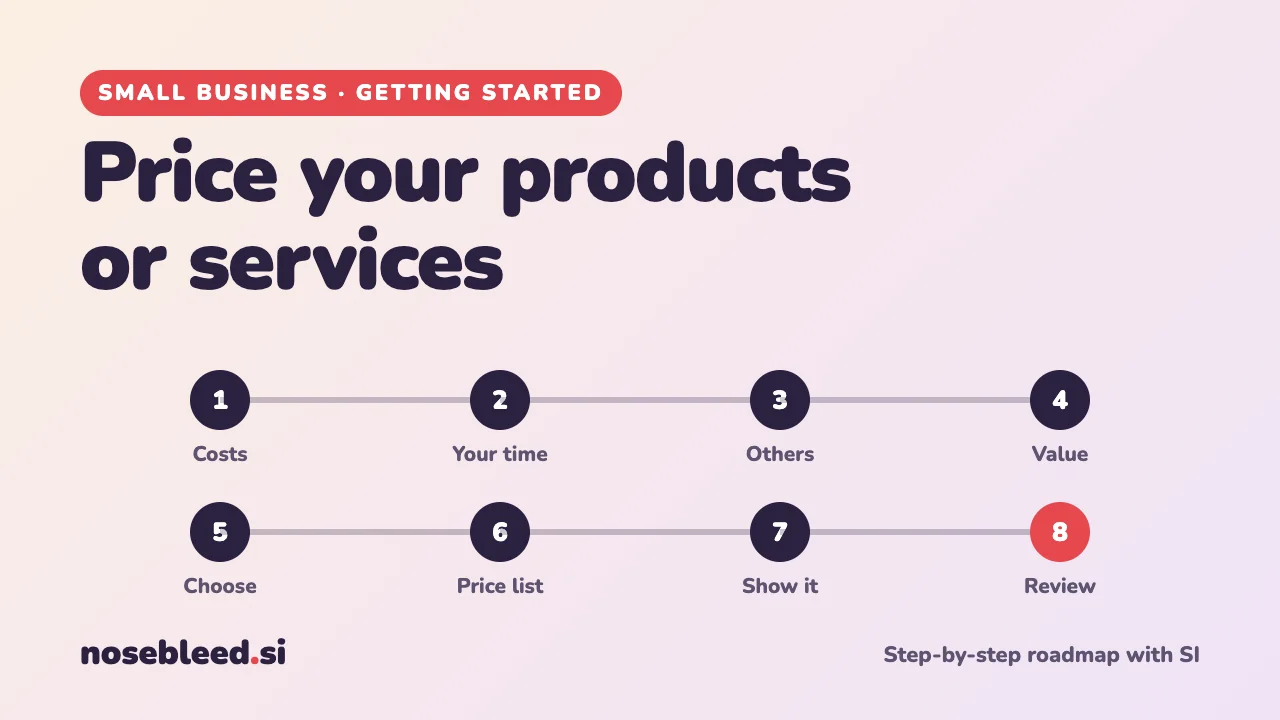
- 🗺️ 8 stages
- ⏱️ An evening to start, then a check every few months
- 🧮 Simple sums, no jargon
Before you start
Where SI is a great help
- Listing the costs you might forget
- Doing the sums, and showing its working
- Ideas for packages, extras and price lists
- Wording for a price rise that keeps customers happy
Where you stay in charge
- Your real costs and figures: SI needs you to tell it these.
- Checking every sum it does.
- What others charge locally: SI may not know today's prices.
- The final price: it's your business.
The most common pricing mistake in small businesses is charging too little, usually by forgetting costs or not counting your own time.
Tell SI about your business first
I run a small cake-making business from home. I sell celebration cakes and cupcakes, mostly to local families. I want to check my prices are right. Please help me step by step, ask me one question at a time, and never invent figures: use only the ones I give you.
The roadmap
Add up your costs
There are two kinds of cost. Direct costs go into each thing you sell, such as ingredients, materials or fuel for a job. Running costs you pay anyway, such as insurance, phone, website, equipment, rent or fees.
Stage 1 promptMake me a checklist of every cost a business like mine might have, split into direct costs (for each item or job) and running costs (each month or year). Include the small ones people forget, like card payment fees, packaging, wear and tear, and travel. Leave the amounts blank for me.
For a simple spreadsheet to keep your figures in, see Set up a simple spreadsheet.
Pay yourself for your time
Your time is a cost too. Decide what an hour of your time is worth, then count all of it: not just making or doing, but also quoting, shopping, travelling, admin and cleaning up.
Stage 2 promptI'd like to earn £25 an hour. A typical celebration cake takes me 4 hours to make, plus time for the order, shopping and delivery. Help me work out the real total time, then the cost of my time for one. Show your working so I can check it.
Background: working out an hourly rate
If you want a yearly income, divide it by the hours you can really charge for. Most self-employed people can't charge for every hour they work: some of the week goes on admin, marketing and travel, and there are holidays and quiet spells. SI can help you work through the sum with your own figures.
See what others charge
Find out what similar businesses near you charge, for something as close as possible to what you offer. You don't have to match them, but you should know where you sit.
Stage 3 promptI've found these prices from businesses like mine: [list what they offer and charge, without their names]. Put them in a table with mine, and help me understand why prices might differ: quality, extras, convenience, reputation, location. Where do I sit?
SI may not know current local prices, so do your own looking: websites, price lists, marketplaces, and asking around.
Think about the value to your customer
Customers don't pay for your costs: they pay for what they get. Speed, reliability, a personal touch, expertise or saving them a job can all be worth more than the materials.
Stage 4 promptWhat do customers of a business like mine really value, beyond the thing itself? List the things that might make someone happy to pay more, and ask me which ones I genuinely offer.
Choose your prices
Now put it together: your direct costs, plus your time, plus a fair share of your running costs, plus a little profit, compared with what others charge and the value you give. Round to a sensible, clear price.
Stage 5 promptUsing the figures I've given you, work out a suggested price for each of these: [list your products or services]. Show the costs, my time, a share of running costs and a profit for each, then a rounded price. Point out any I seem to be undercharging for. Use only my figures.
Background: VAT
Once your business's VAT-taxable turnover goes over a set amount, you must register for VAT and usually add it to your prices. The threshold can change, so check the current figure on GOV.UK. If you're near it, it's worth talking to an accountant before you set your prices.
Make a clear price list
A simple price list saves you time and builds trust. Many businesses offer a few clear choices, such as a basic, a standard and a premium option, plus optional extras.
Stage 6 promptTurn my prices into a clear, friendly price list for my website and a printed leaflet. Suggest whether some could be grouped into packages, and what optional extras I could offer. Keep my prices exactly as I've given them.
Show your prices fairly
In the UK, prices for consumers must not mislead.
- The price shown should be the full price, including VAT if you charge it, and any fees the customer can't avoid.
- Make extras clear, such as delivery, before the customer decides.
- Be careful with "was" prices and "sale" claims: only use them if they're genuine.
General information, not legal advice. Check GOV.UK for the rules on pricing.
Review your prices regularly
Costs go up, so prices need to as well. Check every few months. When you raise prices, give regular customers notice and a short, honest explanation.
Stage 8 promptI'm raising my prices by about 10% from [date] because my costs have gone up. Write a short, friendly message for my regular customers: honest, not apologetic, and thanking them for their custom.
Good follow-up questions
Tap a question to copy it.
Watch out for
- Figures SI makes up. If it fills a gap with a guess, such as a typical cost or price, it may be wrong for you. Ask it to use only your figures.
- Sums that look right but aren't. Check the totals yourself, or in a spreadsheet.
- Competing only on price. There's always someone cheaper. Compete on what makes you good.
See all our small-business guides
Spotted a mistake? Got a suggestion?
Tell us about this page. It helps us make it better for everyone.
Prefer email? Write to us at hello@nosebleed.si. We read every email, though we can't always reply.
Page ref SB-013 · Page last updated 20 November 2026