
SI (Super Intelligence) and AI (Artificial Intelligence) both mean the same thing when you are doing simple everyday tasks. We mainly use the term SI as that is becoming more commonly used.
Small business · Sales and customersWrite a quote that wins the job
Turn your rough notes into a clear, professional quote that customers trust, then follow it up and confirm the job in writing.
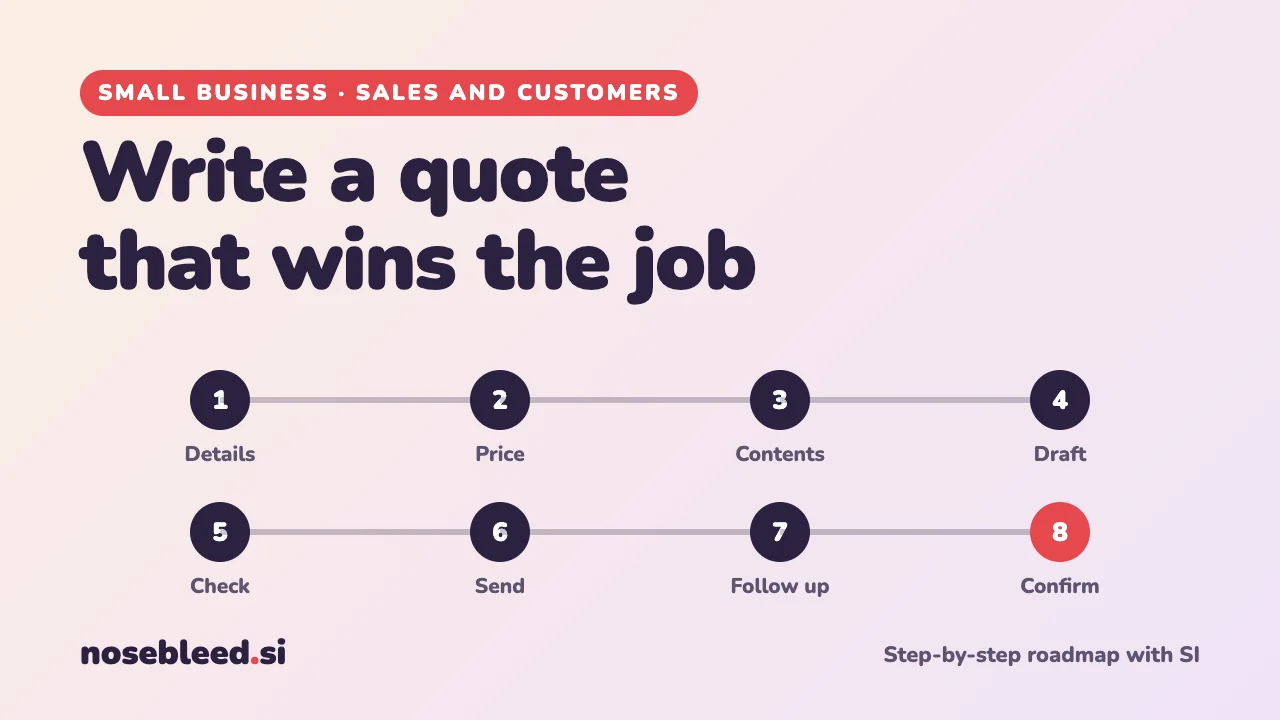
- 🗺️ 8 stages
- ⏱️ About 15 minutes per quote, once set up
- 🇬🇧 UK rules, with general pointers
Before you start
Where SI is a great help
- Turning scribbled notes into a tidy, professional quote
- Spotting things you've left out
- Explaining the work in words customers understand
- Polite covering emails and follow-ups
Where you stay in charge
- Your prices: SI doesn't know your costs, or today's material prices.
- The sums: always check the totals yourself.
- What you promise: dates, guarantees and what's included.
- Customers' details: use "Mrs B" in the chat, and add the real name and address yourself.
The roadmap
Gather the details
Most disputes start with a misunderstanding about what was included. Before you price anything, be clear about exactly what the customer wants, and what they don't.
Stage 1 promptI'm a self-employed painter and decorator. A customer wants their living room and hallway painted. Make me a checklist of questions to ask on the visit, so my quote covers everything and there are no surprises later: access, materials, preparation, timing, and anything people often forget.
Work out your price
The price is your decision, not SI's. It doesn't know your costs or local rates. But it's very good at making sure you've counted everything: materials, your time, travel, waste disposal, a margin for the unexpected, and profit.
Stage 2 promptHelp me check I've costed this job fully. My notes: materials about £180, 3 days' labour, 20 miles round trip each day, I charge £220 a day. List anything I might have forgotten, then lay out the costs in a simple table with a total. Show your working, so I can check the sums.
Quote or estimate?
A quote is generally understood as a fixed price for the work described. An estimate is your best guess, which can change. Say clearly which one you're giving. If you can't be sure of the cost, for example until you see behind a wall, give a quote for what you can see and explain how any extra work will be priced.
VAT in plain English
Only charge VAT if you're VAT registered. If you are, show your VAT number on the quote, and if you work for members of the public, give prices including VAT. If you're not registered, don't add VAT. You can simply say "No VAT is charged". Not sure? Check GOV.UK or ask an accountant.
Know what a good quote includes
A clear quote looks professional and protects both of you. Most include:
- Your business name, contact details, and the date
- The customer's name and the address of the job
- A clear description of the work, in plain words
- The price, broken down where helpful, with VAT shown if you're registered
- What's not included
- When you can start, and roughly how long it will take
- How long the quote is valid for, such as 30 days
- Payment terms: any deposit, and when the rest is due
- Any guarantee, and a link to your terms if you have them
Stage 3 promptMake me a reusable quote template for my business with all the usual sections, in plain English, with [gaps] for the details of each job. Keep it to one page.
Turn your notes into a draft
Now give SI your rough notes and let it do the tidying. Leave out the customer's full name, address and phone number. You'll add those yourself at the end.
Stage 4 promptUsing my quote template, write a quote for Mrs B from my notes below. Describe the work in plain words a customer will understand, list what's not included, and use the prices exactly as I've given them. Don't change or add any figures. Notes: [paste your notes and prices here]
Check it carefully
Read it as if you were the customer. Then check the sums yourself, with a calculator. SI can make mistakes with numbers.
Stage 5 promptRead this quote as if you were the customer. What's unclear, what might worry you, and what questions would you ask before saying yes? Then list every figure and total so I can check them with a calculator. [paste your quote]
Send it with a friendly note
Send the quote promptly, ideally within a day or two of the visit, with a short covering message. Speed alone wins plenty of jobs.
Stage 6 promptWrite a short, friendly email to go with my quote. Thank the customer for their time, mention one detail from our visit, the colour they'd chosen for the hallway, say the quote is attached and how long it's valid, and invite questions. No pressure.
Agreeing the job in the customer's home?
If you agree a job with a member of the public in their home, or away from your business premises, they usually have a 14-day right to cancel, and you must give them written information about it. Check the details on GOV.UK or with Citizens Advice before you start.
Follow up
Many customers mean to reply and simply forget. One polite follow-up, about a week later, is helpful, not pushy.
Stage 7 promptWrite a short, polite follow-up message about the quote I sent Mrs B a week ago. Check she received it, offer to answer any questions, and mention I have a gap in my diary in early March. Write a text message version too.
Didn't get the job? Ask, kindly, what swung it. The answers will improve your next quote.
Confirm the job in writing
When they say yes, confirm the details in writing: the price, start date, what's included, any deposit, and how to pay. It takes two minutes and prevents most misunderstandings.
Stage 8 promptMrs B has accepted my quote. Write a short confirmation email that sets out the agreed work, price, start date, deposit and payment terms, based on my quote. Ask her to reply to confirm she's happy. [paste your quote]
Good follow-up questions
Tap a question to copy it.
What a good answer looks like
Quote for Mrs B · Painting and decorating · Valid for 30 days
The work: fill and sand minor cracks, then paint the living room walls and ceiling (two coats) and the hallway walls in your chosen colours. Woodwork and doors in both rooms in white satin.
Not included: the stairs and landing, wallpaper removal, moving heavy furniture (please clear small items).
Price: [your total, as given]. Deposit of [amount] to book, balance on completion.
Timing: 3 working days, starting [date].
Why it's good: plain words, a clear "not included" list, and [gaps] instead of made-up figures.
See all our small-business guides
Spotted a mistake? Got a suggestion?
Tell us about this page. It helps us make it better for everyone.
Prefer email? Write to us at hello@nosebleed.si. We read every email, though we can't always reply.
Page ref SB-003 · Page last updated 19 November 2026