
SI (Super Intelligence) and AI (Artificial Intelligence) both mean the same thing when you are doing simple everyday tasks. We mainly use the term SI as that is becoming more commonly used.
Small business · Admin and moneyWrite invoices and chase late payment
Send clear invoices that get paid on time, and chase late payers politely, then firmly, without losing the customer or your cool.
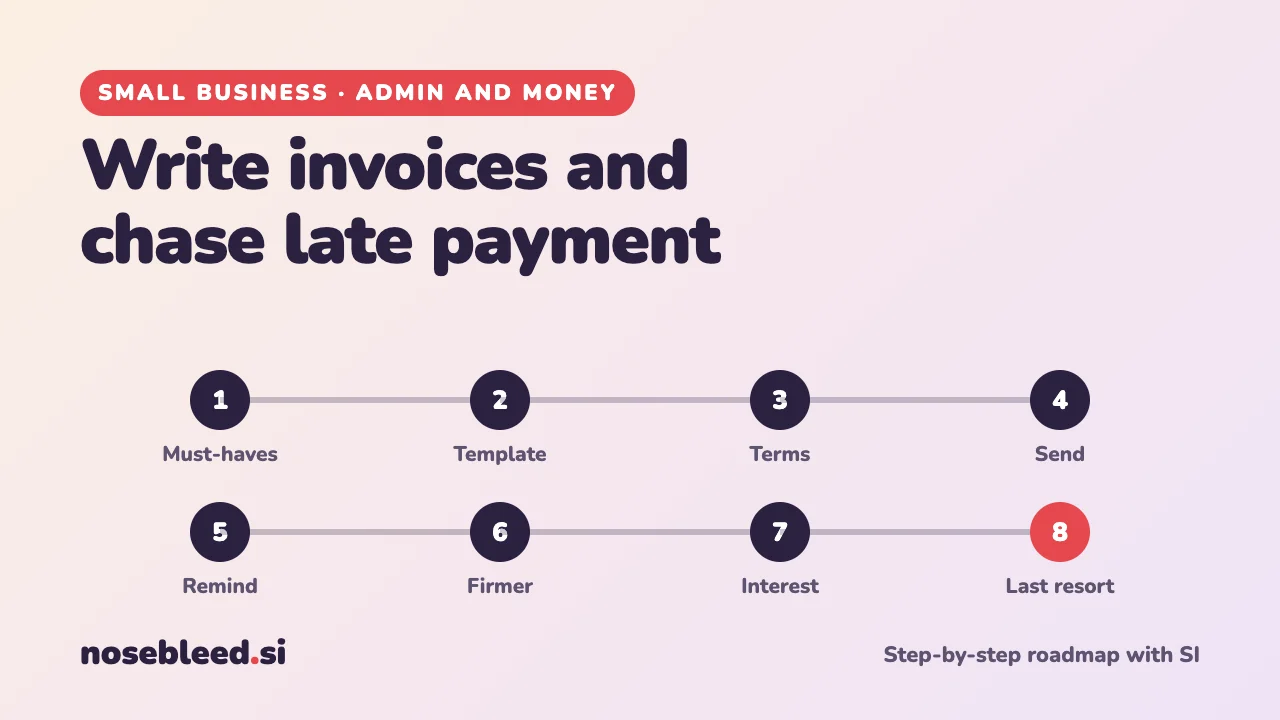
- 🗺️ 8 stages
- ⏱️ 30 minutes to set up
- 🇬🇧 UK rules, with general pointers
Before you start
Where SI is a great help
- A clear, professional invoice template
- Payment terms in plain English
- Reminders that are polite but get results
- Explaining your rights if they don't pay
Where you stay in charge
- The amounts: check every figure and total yourself.
- Your bank details: add them yourself, never paste them into SI.
- Legal steps: check GOV.UK, or take advice, before threatening court.
- The relationship: you know when to be gentle.
The roadmap
Know what an invoice must include
In the UK, an invoice should normally include:
- A unique invoice number, in sequence
- Your business name, address and contact details. A limited company should use its full registered name.
- The customer's name or company name, and address
- The date of the invoice, and the date the goods or services were supplied
- A clear description of what you're charging for, and the amount for each item
- The total amount due
- If you're VAT registered: your VAT number, and the VAT shown separately
Check the full list on GOV.UK ("invoicing and taking payment from customers"). VAT-registered businesses have extra rules.
Make a reusable template
Do this once, and every invoice after takes minutes. A word processor or spreadsheet is fine, and many accounting apps make invoices for you.
Stage 2 promptMake me a simple, professional invoice template for my business, a sole trader garden maintenance business, not VAT registered. Include all the sections a UK invoice should have, with [gaps] for the details, and a short, friendly payment terms line at the bottom. Lay it out so I can copy it into a document.
Add your bank details to the template yourself. Never paste them into an SI chat.
Set clear payment terms
Late payment is often down to unclear terms. Agree them before you start the work, and put them on your quotes and invoices: when payment is due, how to pay, and what happens if it's late.
Payment terms in plain English
"Due within 14 days" is clearer than "net 14". Give a date: "Please pay by 30 March". If you need a deposit for materials, say so on the quote. If no payment date is agreed with another business, the law generally treats payment as due 30 days after the invoice or delivery.
Stage 3 promptWrite short, friendly, clear payment terms for my quotes and invoices. I want payment within 14 days, by bank transfer, and a deposit of 25% for jobs over £500. Plain English, no more than four lines.
Send it promptly
Invoice as soon as the job is done, while the customer is still pleased with your work. A short, warm covering message helps.
Stage 4 promptWrite a short, friendly email to send with my invoice for the autumn garden tidy-up. Thank them, say the invoice is attached, give the amount and due date, and how to pay. Three or four sentences.
Send a polite reminder
Most late payers have simply forgotten. A friendly nudge a day or two after the due date usually does it. Assume the best.
Stage 5 promptWrite a polite, friendly payment reminder. Invoice [number] for £[amount] was due on [date]. Assume they've simply forgotten, reattach the invoice, and remind them how to pay. Write an email and a short text message version.
Follow up more firmly
Still nothing after a week or two? Phone if you can. Then follow up in writing, firmly and politely, with a new deadline. Keep copies of everything.
Stage 6 promptWrite a firm but polite second reminder. Invoice [number] for £[amount] is now three weeks overdue, and my first reminder got no reply. Ask for payment within 7 days, ask them to tell me if there's a problem with the work or the invoice, and say what I'll do next if it isn't paid. Professional, not rude.
Know your rights to interest
If your customer is another business, UK law generally lets you claim interest on late payments, plus a fixed sum towards the cost of chasing, even if your terms don't mention it. Interest is 8% a year above the Bank of England base rate. The fixed sum is £40, £70 or £100, depending on the size of the debt. This doesn't apply to members of the public, unless your agreed terms say so.
Stage 7 promptA business customer owes me £[amount], due on [date]. Explain, in plain English, how statutory late payment interest and compensation work in the UK, and work out roughly what I could claim as of [today's date], assuming the Bank of England base rate is [look it up]. Show your working.
SI may not know the current base rate. Look it up on the Bank of England website, and check GOV.UK's late payment guidance before you claim. Charging interest can sour a relationship, so many businesses use it as a last resort.
The last resort
If they still won't pay, send a formal "letter before action" giving a final deadline. If that doesn't work, you can claim through the courts. In England and Wales, smaller debts can be claimed online. Scotland and Northern Ireland have their own procedures.
Stage 8 promptExplain, in plain English, my options for recovering an unpaid invoice of £[amount] from a business / private customer in England: a letter before action, the court's small claims process, roughly what it costs, and what to consider first. Tell me which official websites to check.
General information, not legal advice. Before going to court, check GOV.UK or speak to an adviser. A court claim costs a fee, and winning doesn't always mean getting paid.
Good follow-up questions
Tap a question to copy it. For setting up a spreadsheet, see Set up a simple spreadsheet.
See all our small-business guides
Spotted a mistake? Got a suggestion?
Tell us about this page. It helps us make it better for everyone.
Prefer email? Write to us at hello@nosebleed.si. We read every email, though we can't always reply.
Page ref SB-005 · Page last updated 19 November 2026