
SI (Super Intelligence) and AI (Artificial Intelligence) both mean the same thing when you are doing simple everyday tasks. We mainly use the term SI as that is becoming more commonly used.
Small business · Sales and customersWrite product descriptions
Turn a list of facts into honest, appealing product descriptions in your own voice, for your website, online marketplaces, social media and shelf labels.
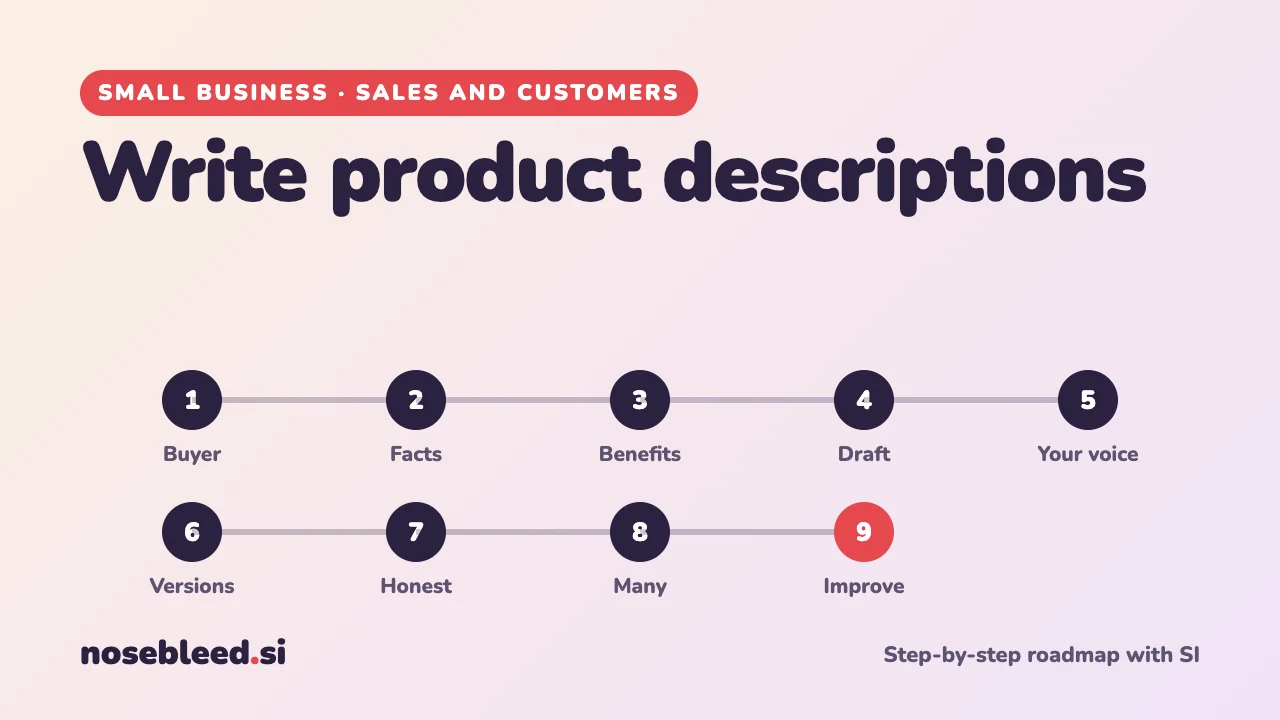
- 🗺️ 9 stages
- ⏱️ Minutes per product, once set up
- 🛍️ Online shops, markets, menus and labels
Before you start
Where SI is a great help
- Turning dry facts into words that make people want to buy
- Short, medium and long versions for different places
- Writing dozens of descriptions in a consistent style
- Spotting what a customer would want to know
Where you stay in charge
- Every fact: sizes, materials, ingredients, care instructions.
- Claims like "handmade", "organic" or "eco-friendly": only if true.
- Safety and allergy information: never leave this to SI.
- Your voice: the thing that makes your shop different.
The roadmap
Know who's buying
A description for a busy parent reads differently from one for a collector. Decide who you're really writing for, and what they care about most.
Stage 1 promptI sell hand-thrown pottery mugs and bowls through my own website and a craft marketplace. Describe my two or three most likely kinds of buyer: what they're looking for, what would make them hesitate, and what they'd want to know before buying.
Gather the facts
SI writes good descriptions only from good facts. For each product, note: what it is, size, materials, colours, how it's made, how to use and care for it, and anything that makes it special.
Stage 2 promptMake me a fact sheet template for my products: every detail a customer might want to know before buying something like mine, with spaces for me to fill in. Include anything I'm legally expected to show.
Turn features into benefits
A feature is a fact: "holds 350ml". A benefit is why it matters: "a proper big mug of tea". Good descriptions have both.
Stage 3 promptHere are the facts about one of my products: [paste your fact sheet]. For each feature, tell me the benefit to my customer, in plain, everyday words.
Write the first draft
Now ask for a description. The shape that works for most products: a short, appealing opening line; two or three sentences on what it's like and why it's special; then the practical details, set out clearly.
Stage 4 promptWrite a product description from these facts: [paste them]. Start with one appealing line, then two or three sentences on what it's like to own and use, then the practical details as a short list. Plain, warm English. No clichés like "elevate" or "must-have". Use only the facts I've given: don't add any.
Make it sound like you
Your voice is what makes customers choose a small business over a big one. Give SI a few examples of how you write, and ask it to match them.
Stage 5 promptHere are two descriptions I wrote myself: [paste them]. Describe my writing style in a few words, then rewrite your draft to match it. Keep the facts exactly the same.
Make versions for different places
The same product needs different words in different places: a full description on your website, a shorter one on a marketplace, a line on social media, a few words on a shelf label or market stall card.
Stage 6 promptFrom this description, make: a product title under 80 characters with the words people would search for; a 50-word marketplace version; a one-line social media caption; and a shelf label of no more than 12 words. [paste your description]
Check every claim is honest
In the UK, product descriptions must not mislead. SI sometimes adds attractive claims that aren't true, so check every word.
- Only say it if you can back it up: "handmade", "organic", "sustainable", "British made", "best", "award-winning".
- Photos must match: what arrives should look like the picture.
- Some products have special rules, such as food (including allergens), cosmetics, toys and electrical goods. Check GOV.UK for your products.
Stage 7 promptCheck this description for any claim that might be exaggerated, unprovable or misleading, and anything a customer might misunderstand. List each one, why it might be a problem, and a safer way to say it. [paste it]
General information, not legal advice.
Do many at once
Got lots of products? Put the facts in a spreadsheet, one product per row, and ask SI to write descriptions in the same style for each. Then check every one.
Stage 8 promptHere's a table of my products, one per row, with their facts: [paste from your spreadsheet]. Write a description for each in the same style as the example we agreed, using only the facts in its row. Return them as a table with the product name and description, so I can paste it back into my spreadsheet.
For spreadsheets, see Set up a simple spreadsheet.
Learn and improve
Notice which products sell well and which don't, and the questions customers keep asking. If people keep asking the same thing, the answer belongs in the description.
Stage 9 promptCustomers keep asking me these questions about my products: [list them]. Rewrite this description so it answers them, without making it much longer. [paste it]
Good follow-up questions
Tap a question to copy it.
What a good answer looks like
Stoneware mug in sea-glass green, 350ml
A proper big mug for a proper cup of tea. Each one is thrown by hand in our Cornish studio, so the glaze pools a little differently every time, and no two are quite alike.
- Holds 350ml
- Dishwasher and microwave safe
- Handmade, so sizes and colours vary slightly
Why it's good: a warm, specific opening, a reason it's special, and the practical facts set out clearly, including an honest note that each one varies.
See all our small-business guides
Spotted a mistake? Got a suggestion?
Tell us about this page. It helps us make it better for everyone.
Prefer email? Write to us at hello@nosebleed.si. We read every email, though we can't always reply.
Page ref SB-011 · Page last updated 19 November 2026