
SI (Super Intelligence) and AI (Artificial Intelligence) both mean the same thing when you are doing simple everyday tasks. We mainly use the term SI as that is becoming more commonly used.
Small business · Sales and customersFollow up a quote
Win more of the work you quote for, with friendly, well-timed follow-ups that help customers decide, without ever feeling pushy.
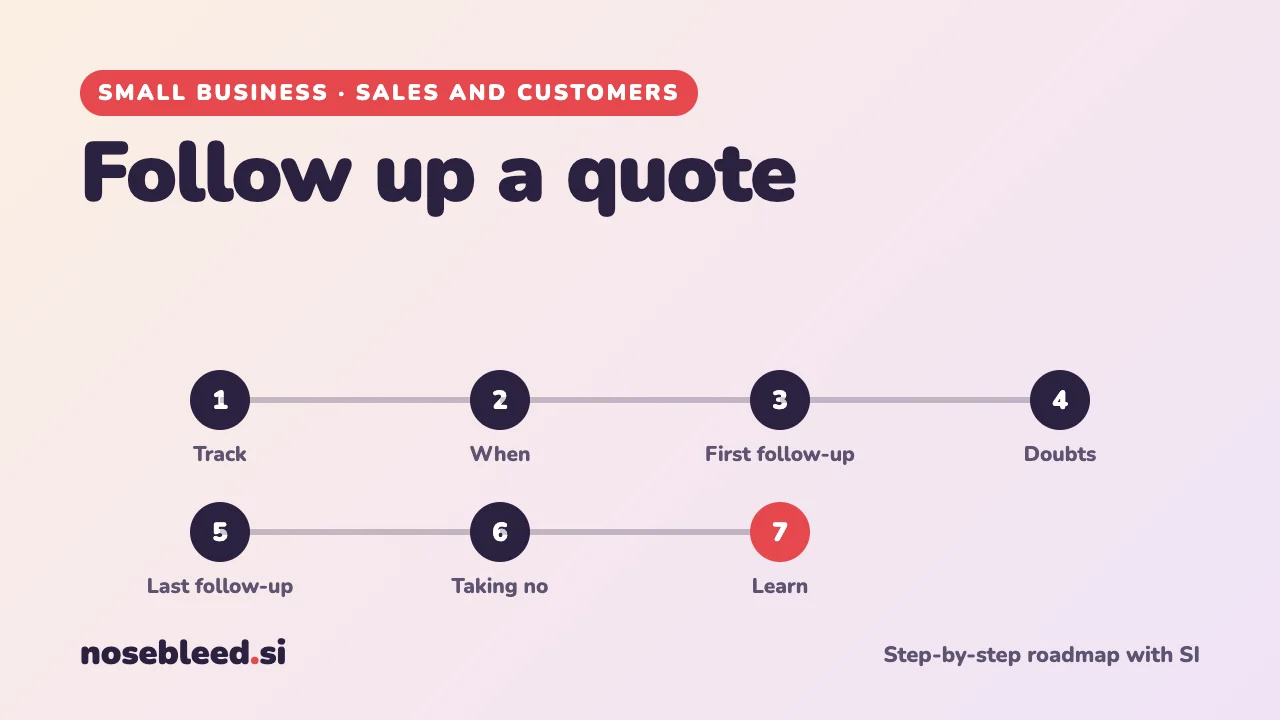
- 🗺️ 7 stages
- ⏱️ Minutes per quote
- 📈 For trades, services and makers
Not sent a quote yet?
This page explains how to follow up a quote you've already sent to a potential customer. If you first need help writing the quote itself, start here:
Before you start
Where SI is a great help
- Friendly follow-up messages that don't feel pushy
- Answering common doubts and questions
- A simple way to keep track of quotes
- Spotting why quotes are won and lost
Where you stay in charge
- Prices, dates and what you've promised.
- Knowing when to stop following up.
- Leaving customers' names out of SI chats.
- Any discount: only if it makes sense for you.
Many customers don't reply simply because they're busy, not because they've said no. A polite reminder is often welcome.
The roadmap
Keep track of your quotes
A simple list stops quotes slipping through the cracks: who it's for, what, how much, the date sent, when to follow up, and what happened.
Stage 1 promptHelp me set up a simple spreadsheet to track my quotes: the columns I need, how to mark which ones need a follow-up this week, and how to see how many I win. Explain it step by step for a beginner.
New to spreadsheets? See Set up a simple spreadsheet.
Know when to follow up
When you send the quote, say when you'll be in touch, and then do it. For most small jobs, a few days to a week later is about right. For bigger jobs, customers may need longer.
Stage 2 promptI'm a landscape gardener and my quotes are usually for jobs between £500 and £5,000. Suggest a simple, polite follow-up plan: when to get in touch, how, and how many times before I stop.
Send a friendly first follow-up
Keep it short and helpful: check they received the quote, offer to answer questions, and make it easy to say yes. A phone call can work well too.
Stage 3 promptWrite a short, friendly follow-up to a customer I quoted a week ago for a new patio. Check they got it, offer to answer questions, and make it easy to book. No pressure. Give me an email version, a text version, and what to say on the phone.
Answer their doubts
If a customer hesitates, find out why. It's often price, timing, or not being sure what's included. A clear, honest answer is better than a discount.
Stage 4 promptThe customer replied: [paste their reply, with names removed]. What might they really be worried about? Help me write an honest, friendly answer that explains the value of my quote without lowering my price. If an option would help, such as a smaller first stage, suggest it.
Send a final, polite follow-up
If you still hear nothing, one last message is fine. Say you'll leave it with them, mention how long the quote is valid, and leave the door open.
Stage 5 promptWrite a short, warm final follow-up for a quote that hasn't had a reply after two messages. Say I won't chase again, remind them the quote is valid until [date], and leave the door open.
Take "no" well
A gracious reply to a "no" leaves a good impression, and customers do come back. If it feels right, ask what made them decide, so you can learn.
Stage 6 promptA customer has told me they've gone with someone else. Write a short, gracious reply that thanks them, wishes them well, and politely asks if they'd share what made the difference. No hard feelings.
Learn from your win rate
Every few months, look at how many quotes you win, which kinds, and why others were lost. Small changes to how you quote and follow up can make a big difference.
Stage 7 promptOver the last six months I sent [number] quotes and won [number]. The ones I lost were mostly [what you know]. What patterns do you see, and what three changes would you try? Use only my figures.
Good follow-up questions
Tap a question to copy it.
Watch out for
- Too many follow-ups. Two or three is plenty. More can put people off.
- Discounting too quickly. Explain the value first. Lower prices hurt your profit on every job.
- Pressure tactics. Fake deadlines and "today only" prices damage trust, and can mislead.
See all our small-business guides
Spotted a mistake? Got a suggestion?
Tell us about this page. It helps us make it better for everyone.
Prefer email? Write to us at hello@nosebleed.si. We read every email, though we can't always reply.
Page ref SB-035 · Page last updated 21 November 2026