
SI (Super Intelligence) and AI (Artificial Intelligence) both mean the same thing when you are doing simple everyday tasks. We mainly use the term SI as that is becoming more commonly used.
Small business · Sales and customersReply to customer enquiries
Reply to every enquiry quickly, warmly and clearly, with ready-made templates that still sound like you, so more enquiries become customers.
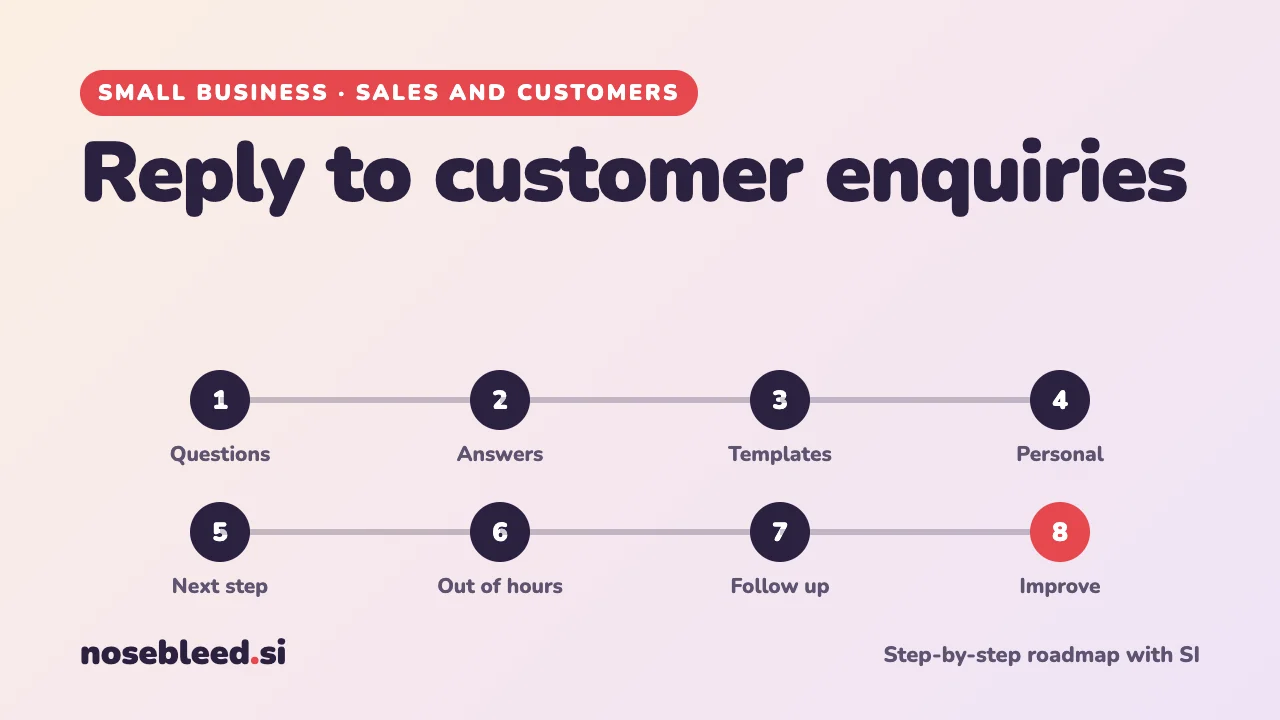
- 🗺️ 8 stages
- ⏱️ An afternoon to set up, then minutes a day
- 💬 Email, website, text and social media messages
Before you start
Where SI is a great help
- Turning your usual answers into ready-made replies
- Making replies clear, warm and short
- Answering tricky or awkward questions politely
- Writing an "away" message and follow-ups
Where you stay in charge
- Prices, dates and availability: always check.
- Promises: only make ones you can keep.
- Leaving customers' names and details out of SI chats.
- Reading every reply before you send it.
Speed matters. Many people ask several businesses at once, and the first clear, friendly reply often wins the work.
Tell SI about your business first
I run a window cleaning business. Customers usually contact me by phone, text and my website form. I'd like to reply faster and more clearly, with ready-made replies that still sound like me. Please help me step by step, and ask me anything you need to know first.
The roadmap
List the questions you're asked most
Most businesses get the same ten or so questions again and again: prices, availability, the area you cover, how long it takes, how to pay. Write them down.
Stage 1 promptWhat questions do customers usually ask a business like mine before they buy or book? List the 15 most likely, from the most common, so I can tick the ones I get and add my own.
Write your best answers
Answer each question once, properly: clear, friendly and short. These become the building blocks for every reply.
Stage 2 promptHere are my common questions and my rough answers: [paste them]. Turn each into a clear, friendly answer of two or three sentences. Keep my facts exactly as I've given them, and mark anything that needs a real price or date with [CHECK].
Put the same answers on your website as "frequently asked questions". It saves you time, and customers find answers before they ask.
Make ready-made reply templates
A handful of templates covers most enquiries: a quote request, a "yes, I can do that", a "sorry, I can't", a request for more details, and a booking confirmation.
Stage 3 promptWrite five short reply templates for my business: (1) thanks, here's a price; (2) thanks, I need a few more details; (3) yes, I can book you in; (4) sorry, I can't help, and who might; (5) booking confirmed. Each under 100 words, warm and clear, with [gaps] for names, prices and dates.
Keep your templates somewhere easy to copy from, such as a notes app, your email's saved replies, or a document.
Make each reply personal
A template is a starting point. Always use the customer's name, answer exactly what they asked, and add one personal line. People can tell when a reply is just copied.
Stage 4 promptA customer has asked: [paste their message, with their name and details removed]. Using my templates and answers, write a reply that answers exactly what they asked, with one friendly personal touch. Under 120 words.
Leave out names, addresses and phone numbers when you ask SI, and add them yourself afterwards. How to hide personal details
Always give a clear next step
End every reply with one clear thing to do: book a date, send a photo, reply with their postcode, or call you. Enquiries without a next step often fizzle out.
Stage 5 promptRead my reply and make the next step clearer and easier for the customer, in one or two sentences. [paste your reply]
Reply even when you're busy
If you can't answer straight away, an automatic "away" reply, or a quick "thanks, I'll get back to you by tomorrow", stops customers going elsewhere.
Stage 6 promptWrite a short, friendly automatic reply for when I'm out on jobs or after hours: thank them, say when I'll reply, and answer the two most common questions so they don't have to wait. Then a two-line version for text messages.
Follow up, once
If someone asked for a price and went quiet, one polite follow-up a few days later often wins the work. Once is enough.
Stage 7 promptWrite a short, friendly follow-up for a customer who asked for a price four days ago and hasn't replied. Not pushy, easy to say yes or no to.
For bigger jobs with written quotes, see Write a quote that wins the job.
Keep improving
Every few months, look at which enquiries became customers and which didn't. Update your answers and templates with anything new people keep asking.
Stage 8 promptOver the last three months I had [number] enquiries and [number] became customers. The ones that didn't usually [what happened]. What could I change in how I reply to win more of them?
Good follow-up questions
Tap a question to copy it.
What a good answer looks like
Hi [name],
Thanks for getting in touch. Yes, I cover [village], and a three-bedroom house like yours is usually [price] for the outside windows, frames and sills.
I could fit you in on [day] or [day]. Just reply with whichever suits you, and I'll confirm.
Best wishes, [your name]
Why it's good: it answers exactly what was asked, gives a price and a choice of dates, and ends with one simple next step. The [gaps] are for your own details.
See all our small-business guides
Spotted a mistake? Got a suggestion?
Tell us about this page. It helps us make it better for everyone.
Prefer email? Write to us at hello@nosebleed.si. We read every email, though we can't always reply.
Page ref SB-017 · Page last updated 20 November 2026