
SI (Super Intelligence) and AI (Artificial Intelligence) both mean the same thing when you are doing simple everyday tasks. We mainly use the term SI as that is becoming more commonly used.
Small business · Staff, helpers and suppliersWrite a job advert
Write a clear, friendly job advert that attracts the right people, treats everyone fairly and stays within the rules.
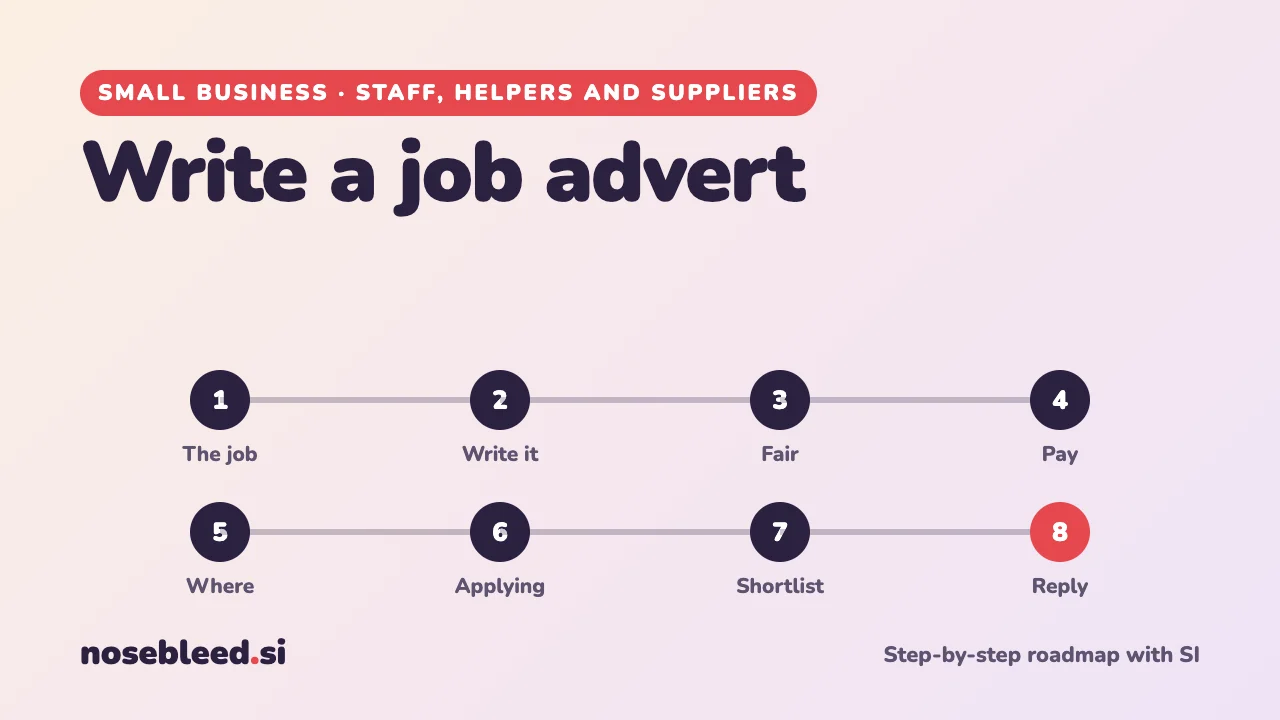
- 🗺️ 8 stages
- ⏱️ An hour or two
- 🇬🇧 UK rules, with general pointers
Before you start
Where SI is a great help
- Turning your notes into a clear job description
- Writing an advert that sounds welcoming
- Spotting words that might put people off unfairly
- Shortlisting and reply templates
Where you stay in charge
- The real job, the pay and the hours.
- Checking the rules: pay, fairness, right to work.
- Keeping applicants' details out of SI chats.
- Choosing who to hire.
Acas gives free, impartial advice to employers on hiring and employing people, including a helpline. This page is general information, not legal advice.
The roadmap
Decide what the job really is
Before you write anything, be clear about the work: the main tasks, the hours, where it's done, and what the person really needs to be able to do from day one, as opposed to what they could learn.
Stage 1 promptI run a small café and need a part-time kitchen assistant. Interview me one question at a time about the job: tasks, hours, what's essential and what could be learned. Then write a short job description with the main tasks, and the skills split into "essential" and "nice to have".
Background: employee, worker or self-employed?
Taking someone on as an employee is different from using a self-employed helper or a freelancer, with different rights and responsibilities, including pay, holiday, tax and pensions. It depends on how the work is really done, not just what you call it. GOV.UK and Acas explain the differences.
Write the advert
A good advert is short and honest. Lead with the job, the pay and the hours, then say what the work involves, who you're looking for, and why someone would enjoy working with you.
Stage 2 promptFrom this job description, write a job advert of about 200 words. Start with the job title, pay, hours and place. Then a few lines about the work, who we're looking for, and what it's like to work here. Warm, plain English, no jargon. End with how to apply and the closing date. [paste your job description]
Check it's fair
In the UK, it's against the law to discriminate against job applicants because of age, disability, gender reassignment, marriage or civil partnership, pregnancy or maternity, race, religion or belief, sex or sexual orientation. Some everyday words can suggest this without meaning to.
- Avoid words that point to age, such as "young", "energetic", "recent graduate" or "mature".
- Ask only for what the job needs: "a full driving licence" only if driving is part of the job.
- Describe skills, not people: "good spoken English" rather than "native English speaker".
Stage 3 promptCheck this job advert for any words or requirements that might discourage people unfairly or suggest discrimination under UK law, such as hints about age or sex, or requirements the job doesn't really need. List each one, why it might be a problem, and a fairer way to say it. [paste your advert]
Get the pay and hours right
Say the pay clearly: adverts with the pay shown usually get more applicants. Check it's at least the legal minimum for the person's age. The National Minimum Wage and National Living Wage rates change every April, so check them on GOV.UK.
Stage 4 promptExplain in plain English what I need to know about paying a part-time employee in the UK: minimum pay, holiday, payslips, and anything else a first-time employer often misses. Tell me where to check the current rules and rates, and don't give me figures you're unsure are current.
Choose where to advertise
For a small local job, often the best places are close to home: your shop window, your website and social media, local community groups, and word of mouth. There are also free and paid online job sites, and the government's own Find a Job service.
Stage 5 promptSuggest the best places to advertise a part-time kitchen assistant job in a small market town, free ones first. Then make me three versions of my advert: full length for a job site, a short one for social media, and a window card.
Make applying simple
Decide how people apply, such as a short email, a simple form, or popping in, and give a closing date. Ask only for the information you need at this stage.
Stage 6 promptWrite a short, simple application form for this job: only the questions I really need to shortlist fairly. Include a line about how I'll use and look after their information.
Applicants' details are personal information. Keep them safe, and don't keep them longer than you need. See Keep customer information safe.
Shortlist fairly
Decide what you're looking for before you read the applications, then score everyone against the same short list. It's fairer, and it makes the choice easier.
Stage 7 promptFrom my job description, make me a simple shortlisting sheet: five or six things I'm looking for, with a score from 1 to 3 for each and a space for notes. Base it only on what the job needs.
Do the scoring yourself. Don't paste applicants' names, details or applications into SI.
Reply to everyone, and check the right to work
Let every applicant know the outcome, even with a short note. It's kind, and it protects your reputation locally. Before someone starts, you must check they have the right to work in the UK. GOV.UK explains how.
Stage 8 promptWrite three short, kind templates: inviting someone to an interview or trial shift, telling someone they haven't been shortlisted, and offering someone the job, subject to right to work checks. Leave [gaps] for names, dates and times.
Good follow-up questions
Tap a question to copy it.
Watch out for
- Pay rates SI isn't sure of. Minimum pay changes every year. Always check GOV.UK.
- Requirements the job doesn't need. They can shrink your pool of applicants, and may be unfair.
- Applicants' details in SI chats. Keep names, CVs and contact details out.
See all our small-business guides
Spotted a mistake? Got a suggestion?
Tell us about this page. It helps us make it better for everyone.
Prefer email? Write to us at hello@nosebleed.si. We read every email, though we can't always reply.
Page ref SB-018 · Page last updated 20 November 2026