
SI (Super Intelligence) and AI (Artificial Intelligence) both mean the same thing when you are doing simple everyday tasks. We mainly use the term SI as that is becoming more commonly used.
Small business · MarketingWrite a press release
Turn something genuinely interesting about your business into a short, clear press release that local journalists can use, and get free coverage.
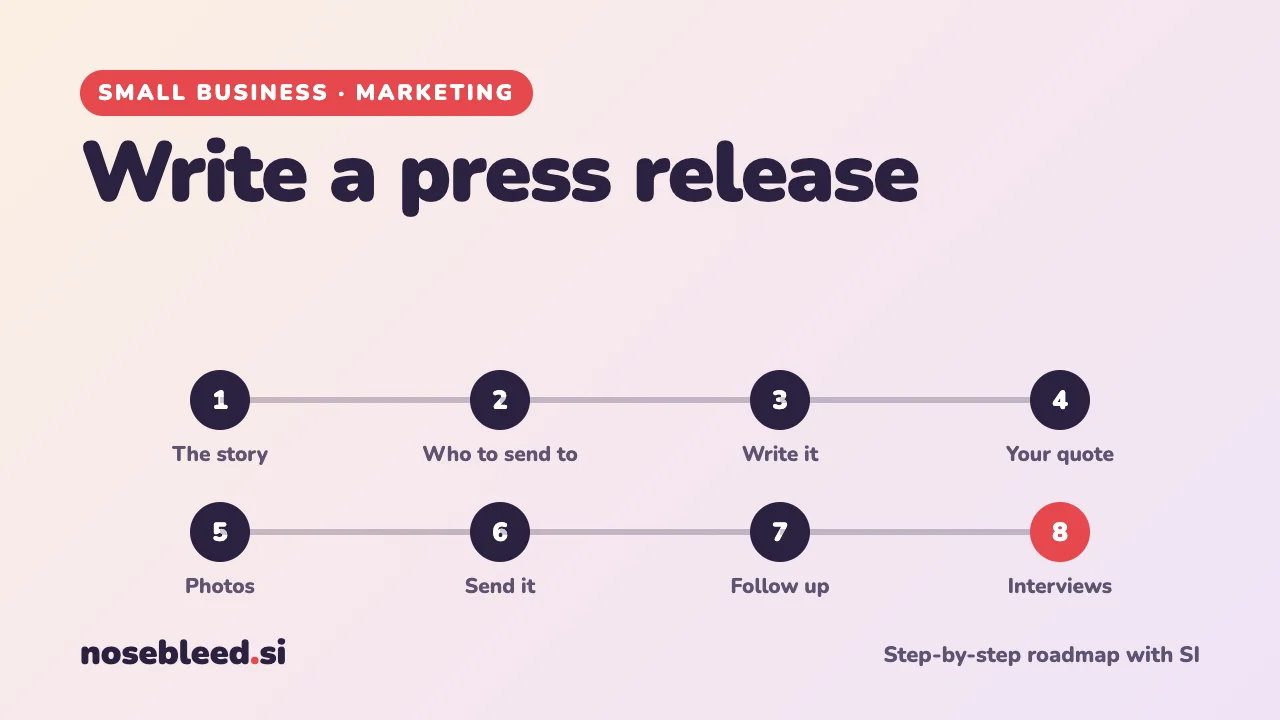
- 🗺️ 8 stages
- ⏱️ An evening per press release
- 📰 Local papers, radio, websites and trade press
Before you start
Where SI is a great help
- Finding the news in your business
- Writing in the style journalists expect
- Headlines and short versions
- Preparing for questions
Where you stay in charge
- Every fact, name, date and figure.
- Your quote: it must be your own words.
- Permission from anyone named or pictured.
- Which journalists to contact.
Local journalists are often busy and short of stories. A clear, ready-to-use press release about something genuinely interesting makes their job easier.
Tell SI about your business first
I run a small independent bookshop in a market town. I'd like to get some coverage in the local paper and on local radio. Here's what's happening in my business: [anything new, unusual, or coming up]. Please help me step by step, and ask me anything you need to know first.
The roadmap
Find a real story
"We're open" isn't news. A story is something new, unusual, local, or about people: an anniversary, an award, a new service, helping the community, a local first, an event, or an interesting person behind the business.
Stage 1 promptFrom what I've told you about my business, suggest five possible news stories a local journalist might be interested in. For each, say why it's newsworthy and which kind of media might like it. Be honest about which are strongest.
Choose who to send it to
Think local papers and their websites, local radio, community magazines, and trade magazines for your industry. Find the right person's email address on their website, usually a news desk or a named reporter.
Stage 2 promptWhat kinds of local and trade media might be interested in a story like mine? Tell me what to look for and how to find the right contact at each. Don't name specific publications you're not sure exist.
Write the press release
Keep it to one page. A clear headline, then the most important facts in the first paragraph: who, what, when, where and why. Then more detail, a quote, and your contact details at the end.
Stage 3 promptWrite a one-page press release about [your story], using only these facts: [list them]. A clear headline; a first paragraph with who, what, when, where and why; two short paragraphs of detail; a space marked [YOUR QUOTE]; and "For more information" with [gaps] for my contact details. Plain English, no hype.
Add a quote in your own words
Journalists like a quote from a real person. It must be something you, or whoever is quoted, would genuinely say. If SI suggests wording, make sure it's truly yours, and get permission before quoting anyone else.
Stage 4 promptInterview me with three questions about why this story matters to me and to the community. Then help me shape my own answers into one or two short sentences I could use as my quote, keeping my words.
Offer good photos
A good photo can be the difference between a story being used or not. Offer one or two clear, well-lit photos of people, not just products or buildings. Make sure you have permission from anyone in them.
Send it
Paste the press release into the body of the email, not just as an attachment, with a clear subject line. Attach one or two photos, and send each journalist their own email.
Stage 6 promptWrite a short email to a local journalist introducing my press release. A clear subject line, two sentences on why their readers would be interested, and a note that photos are attached and I'm available for interview.
Follow up, once
If you hear nothing after a few days, one short, polite follow-up is fine. If they don't use it this time, don't be discouraged: build the relationship for next time.
Be ready for an interview
A journalist may call or ask you on the radio. Prepare three key points, and practise saying them simply.
Stage 8 promptA local radio presenter might interview me about [your story]. Ask me the ten questions they're most likely to ask, one at a time, and give me feedback on my answers. Then help me sum up my three key points.
Once you're featured, share it: on your website, social media and newsletter. See Plan a month of social media posts.
Good follow-up questions
Tap a question to copy it.
Watch out for
- Quotes SI makes up. Never use words someone didn't say. Write or approve every quote yourself.
- Adverts dressed up as news. Journalists ignore them. Focus on the story, not the sales pitch.
- Paying for "editorial". If someone asks for money to cover your story, it's advertising, and may need to be labelled as such.
See all our small-business guides
Spotted a mistake? Got a suggestion?
Tell us about this page. It helps us make it better for everyone.
Prefer email? Write to us at hello@nosebleed.si. We read every email, though we can't always reply.
Page ref SB-037 · Page last updated 21 November 2026