
SI (Super Intelligence) and AI (Artificial Intelligence) both mean the same thing when you are doing simple everyday tasks. We mainly use the term SI as that is becoming more commonly used.
Small business · Getting startedWrite a simple business plan
Start with a one-page plan in an evening, then build it into a fuller plan for a bank or grant when you need one.
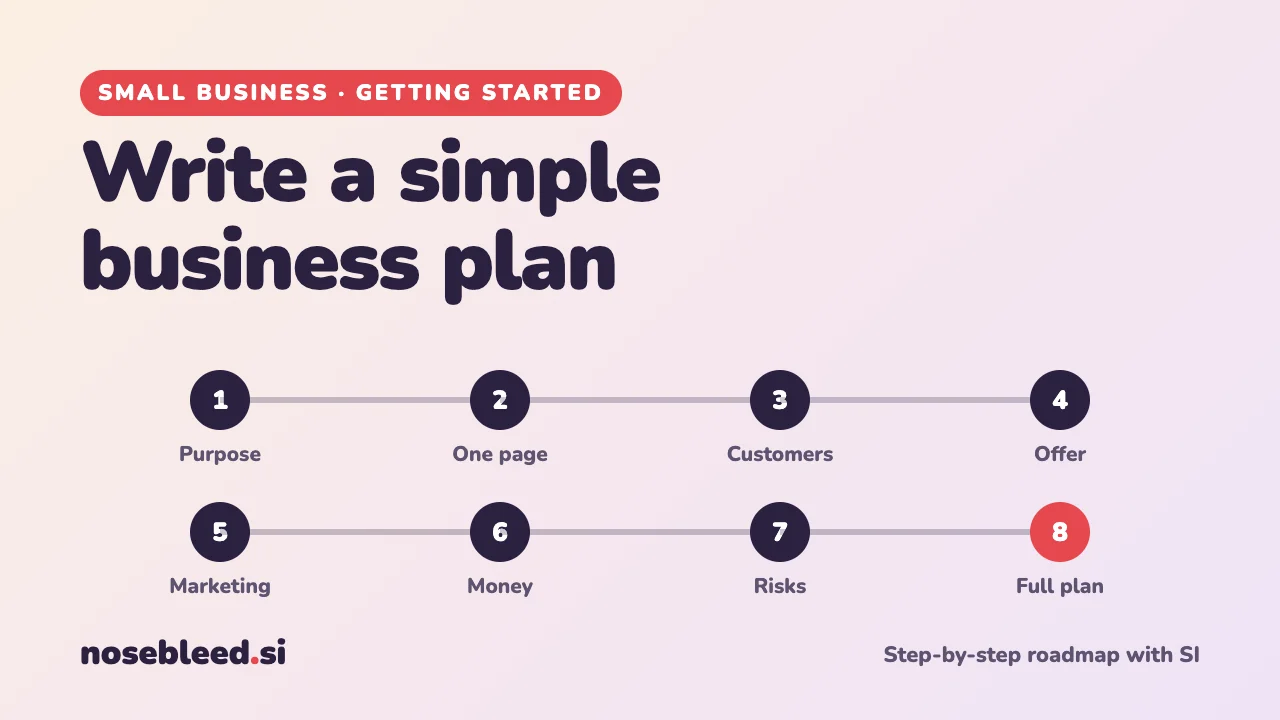
- 🗺️ 8 stages
- ⏱️ An evening for one page, a few weeks for a full plan
- 🇬🇧 UK pointers
Before you start
Where SI is a great help
- Asking the questions a good adviser would ask
- Turning your ideas into clear, organised sections
- Spotting gaps, weak spots and risks
- Laying out simple money tables for you to fill in
Where you stay in charge
- The numbers: SI can't know your real costs, prices or local market.
- Research: check any facts and figures it gives you.
- The big decisions, and any borrowing.
- Financial advice: talk to an accountant or business adviser.
The roadmap
Decide what the plan is for
A plan just for you can be one page. A plan for a bank, lender or grant needs more detail, especially about money. Know your reader before you start.
Stage 1 promptI'm planning to start a mobile bike repair business in Bristol. I need a business plan for myself at first, and maybe later for a start-up loan. Explain what each kind of plan needs, then interview me, one question at a time, so you understand my idea.
Write a one-page plan
A one-page plan makes you get to the point. It covers: what you'll sell, to whom, why they'll choose you, how they'll find you, what it costs to run, and what you hope to earn.
Stage 2 promptFrom everything I've told you, write a one-page business plan with these headings: the idea, customers, why they'll choose me, how they'll find me, costs, prices and income, and my first three goals. Plain English. Mark anything you've guessed with [CHECK].
Understand your customers and competitors
Who exactly will buy, and who else are they buying from now? SI can help you think it through, but the best research is talking to real potential customers.
Stage 3 promptHelp me research my market. (1) Describe two or three typical customers for my business: who they are, what they need, and what worries them. (2) List the kinds of competitor they might use instead, and how I could stand out. (3) Write ten questions I could ask potential customers face to face.
SI may not know your local area or today's competitors. Check by searching online and walking round your patch.
Define your offer and prices
Be clear about exactly what you sell and what it costs. Your prices must cover your costs and your time, with something left over.
Stage 4 promptHelp me set out my services and prices in a simple table. Here are my services and my rough costs for each: [list them]. Show the cost, my proposed price and the difference, and point out any that look underpriced. Don't invent figures. Use only mine.
Plan your marketing
How will customers hear about you in the first three months? Keep it to a few things you can really do well.
Stage 5 promptSuggest a simple marketing plan for my first three months, with a budget of £300 and about three hours a week. Mix free and paid ideas, put them in order of what to do first, and say how I'd know each one was working.
See also Create a website for your business and Plan a month of social media posts.
Work out the money
Three simple tables cover most small plans:
- Start-up costs: what you need to spend before you open.
- Running costs: what it costs each month, whether you sell anything or not.
- Cash flow: money in and money out, month by month, for the first year, so you can see when cash might run short.
Stage 6 promptLay out three simple tables I can fill in, for a spreadsheet: start-up costs, monthly running costs, and a 12-month cash flow forecast. Add rows for the usual costs a business like mine has, so I don't forget any, but leave the amounts blank for me. Then explain, in plain English, how to read the cash flow table.
Fill in the figures yourself, and check every sum. An accountant or business adviser can check your forecast before you borrow. For spreadsheets, see Set up a simple spreadsheet.
Think about the risks
What could go wrong, and what would you do? Lenders like to see that you've thought about it, and so should you.
Stage 7 promptPlay devil's advocate. What are the ten biggest risks to my business plan? For each, say how likely it is, how much it would hurt, and one practical way to reduce it. Be honest, not encouraging.
Build the full plan, when you need it
Applying for a loan or grant? Your lender may have its own template: use it. If not, SI can help turn your one-page plan, research, money tables and risks into a full plan, typically with an executive summary at the front.
Stage 8 promptUsing everything we've worked on, draft a full business plan for a start-up loan application, with the usual sections and a one-page executive summary at the front. Keep my own words where you can, and mark anything that needs evidence or checking with [CHECK].
Free help in the UK: the government-backed Start Up Loans scheme offers free business plan templates, and local business support services (Growth Hubs in England, Business Gateway in Scotland, Business Wales and Invest Northern Ireland) offer free advice. Search their names online.
Good follow-up questions
Tap a question to copy it.
See all our small-business guides
Spotted a mistake? Got a suggestion?
Tell us about this page. It helps us make it better for everyone.
Prefer email? Write to us at hello@nosebleed.si. We read every email, though we can't always reply.
Page ref SB-007 · Page last updated 19 November 2026