
SI (Super Intelligence) and AI (Artificial Intelligence) both mean the same thing when you are doing simple everyday tasks. We mainly use the term SI as that is becoming more commonly used.
Small business · Protect your businessCheck what SI tells you
Use SI with confidence by knowing what to check, how to check it quickly, and when to take proper advice.
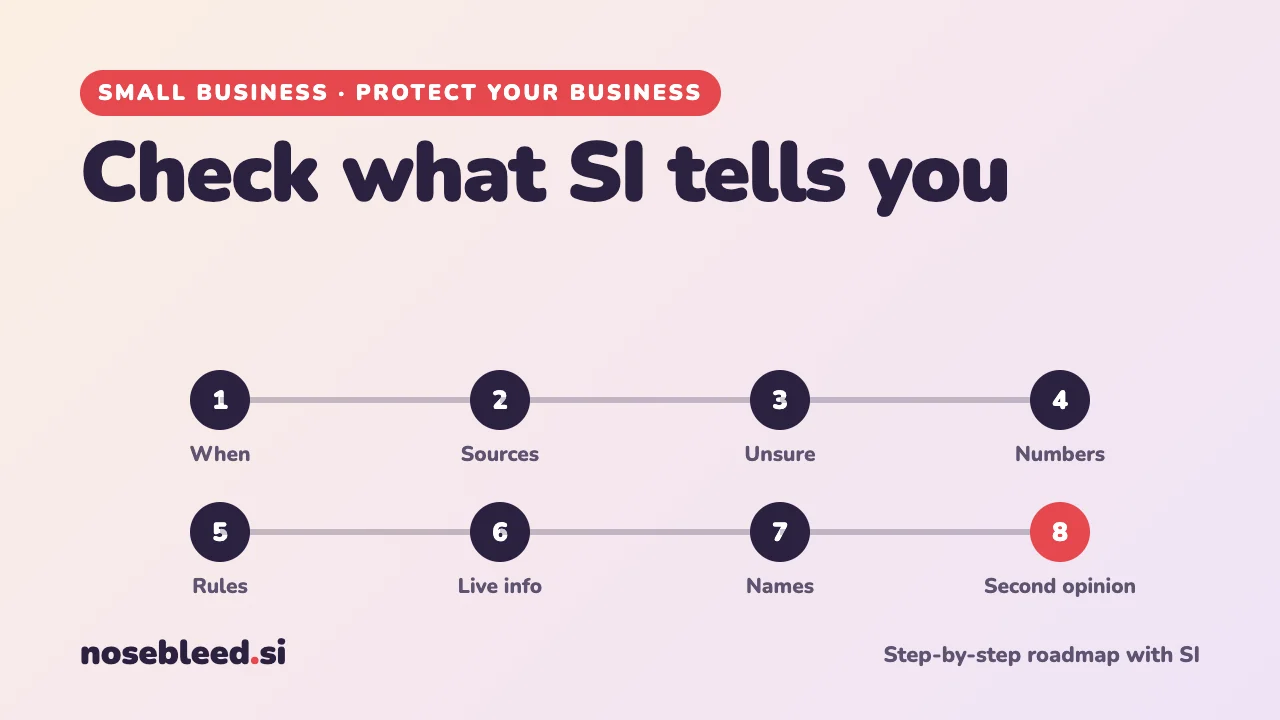
- 🗺️ 8 stages
- ⏱️ A few minutes per answer
- ✅ Works with any SI assistant
Before you start
What SI does brilliantly
- Explaining things in plain English
- First drafts, ideas and checklists
- Organising your own information
- Pointing you to where to check
Where it can go wrong
- Sounding sure when it's wrong.
- Out-of-date rules, rates and prices.
- Sums that look right but aren't.
- Made-up names, figures and sources.
SI is a brilliant assistant, but you're the one in charge. The more an answer matters, the more carefully you check it.
The roadmap
Know when to check
You don't need to check everything. A social media post idea is low risk. Anything involving money, the law, safety, health, or what you tell customers needs checking every time.
- Low risk: ideas, wording, layouts. Just read it through.
- Check it: facts, figures, dates, prices, names.
- Check it, and take advice if it matters: tax, contracts, employment, data protection, safety.
Ask where it came from
Ask SI where you can check what it's told you. Then look at the source yourself: SI can sometimes name sources that don't exist, or don't say what it claims.
Stage 2 promptWhich official websites or organisations should I check to confirm what you've just told me? Tell me what to search for on each. If you're not sure, say so.
Invite it to say when it's unsure
SI often sounds equally confident whether it's right or wrong. Asking it directly can bring doubts to the surface.
Stage 3 promptGo back through your answer. Which parts are you most and least sure of? Which might be out of date, or different in the UK? Mark anything I should check with [CHECK].
Check the numbers
SI can make mistakes with sums, and sometimes fills gaps with figures it has guessed. Always ask it to show its working, and to use only your figures. Then check the totals yourself, or in a spreadsheet.
Stage 4 promptShow your working for every calculation, step by step. Have you used only the figures I gave you? List any figure you've assumed or estimated.
Check laws and rules at the source
Rules change, and they differ between countries, and even between England, Scotland, Wales and Northern Ireland. For the UK, the official places to check are usually:
- GOV.UK for tax, employment, business rules and most government services.
- The ICO for data protection.
- Acas for employing people.
- Business Companion (from Trading Standards) for selling to the public.
For anything serious, such as a contract, a dispute or a large sum, take professional advice.
Check anything that changes
Some SI assistants can search the web, and some can't. Even when they can, prices, opening times, rates, thresholds and deadlines may be out of date. SI may not know the current figure, so check it yourself.
Stage 6 promptIs any of the information you've given me likely to change from year to year, such as rates, thresholds, prices or deadlines? List those parts, and tell me where to find the current figures.
Check names, quotes and examples
SI can invent things that sound real: business names that already belong to someone, quotes nobody said, reviews, statistics, or organisations that don't exist. Before you use a name, search for it. Never publish a quote or figure you can't trace.
Choosing a name? See Choose a business name.
Get a second opinion
For anything that matters, ask the question a different way, start a new chat, or ask a different SI assistant. If the answers disagree, that's your cue to check properly. And for important decisions, a person who knows your business, such as an accountant, adviser or solicitor, is worth the cost.
Stage 8 promptPlay devil's advocate with your own answer. What might be wrong with it, what have you left out, and when would this advice not apply?
Good follow-up questions
Tap a question to copy it.
Watch out for
- Confident answers. Confidence isn't the same as being right.
- Links and sources SI gives you. Open them and check they say what SI claims.
- Answers that tell you what you hoped to hear. Ask SI to argue the other side.
See all our small-business guides
Spotted a mistake? Got a suggestion?
Tell us about this page. It helps us make it better for everyone.
Prefer email? Write to us at hello@nosebleed.si. We read every email, though we can't always reply.
Page ref SB-021 · Page last updated 20 November 2026