
SI (Super Intelligence) and AI (Artificial Intelligence) both mean the same thing when you are doing simple everyday tasks. We mainly use the term SI as that is becoming more commonly used.
Small business · Staff, helpers and suppliersCompare supplier quotes
Compare quotes fairly and confidently, so you choose the best value, not just the lowest price, and avoid nasty surprises in the small print.
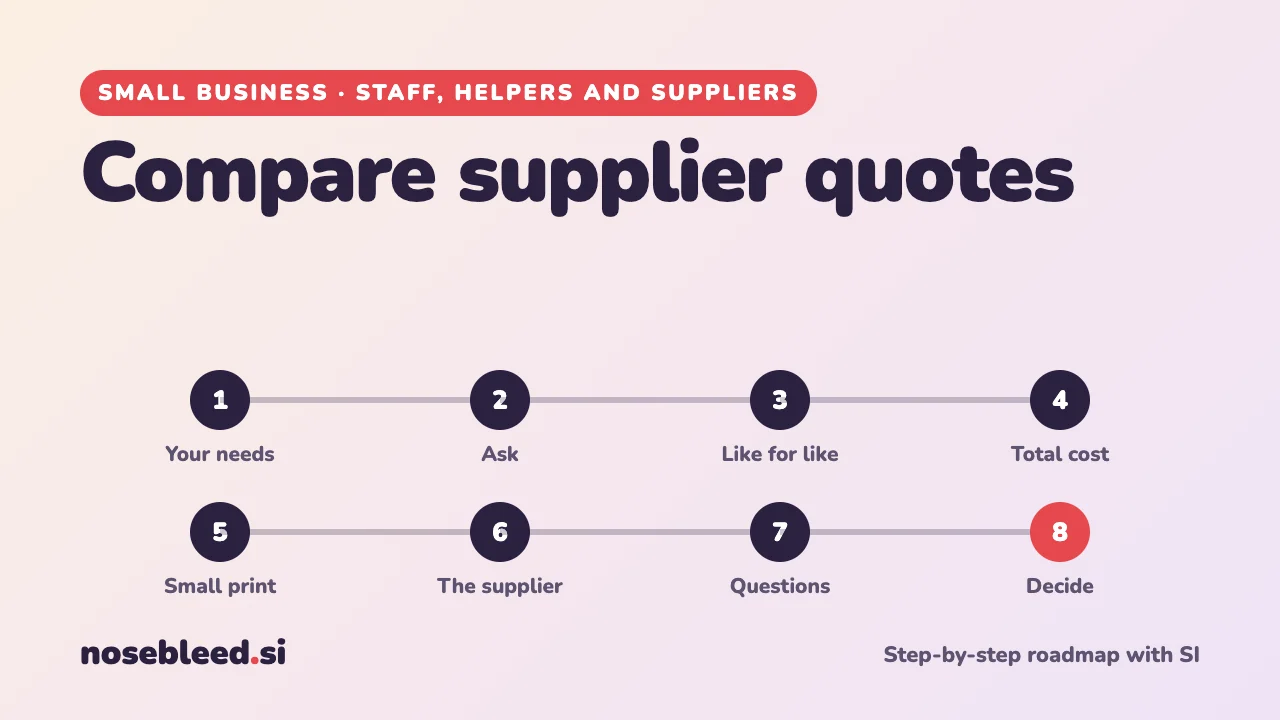
- 🗺️ 8 stages
- ⏱️ An hour or two per big decision
- 🤝 For goods, services and contracts
Before you start
Where SI is a great help
- Turning different quotes into one clear table
- Spotting what's missing or unclear
- Explaining the small print in plain English
- Questions to ask before you sign
Where you stay in charge
- Checking every figure against the quotes.
- Removing names and account details before sharing.
- Reading the contract yourself before you sign.
- Taking advice on big or long contracts.
Businesses buying from other businesses generally have fewer legal protections than consumers, so the small print matters more. Before you rely on what SI tells you about contracts, see Check what SI tells you.
The roadmap
Be clear about what you need
Before asking for quotes, write down what you need: what, how much, how often, by when, and anything that really matters to you, such as quality, speed or local service.
Stage 1 promptI need a new commercial oven for my small bakery. Interview me one question at a time about what I really need, then write a short, clear description I can send to suppliers so they all quote for the same thing.
Ask everyone the same way
Send the same description to each supplier, and ask them all for the same things: price, what's included, delivery, timings, and terms. Three quotes is often enough.
Stage 2 promptWrite a short, polite email asking a supplier for a quote, based on my description. Ask them to include the total price with and without VAT, what's included, delivery, timings, payment terms, any contract length, and how long the quote is valid.
Compare like with like
Quotes rarely match neatly. One includes installation, another doesn't; one is per month, another per year. Put them side by side in one table.
Stage 3 promptHere are three quotes, with supplier names replaced by A, B and C: [paste or describe them]. Put them in one table so I can compare like with like: price, what's included, what's extra, delivery, timings and terms. Highlight anything missing or unclear in each. Use only the figures in the quotes.
You can attach a photo or PDF of each quote, with names and account details covered. How to attach a file
Work out the true total cost
The cheapest price isn't always the cheapest choice. Add up everything over the time you'll use it: set-up, delivery, VAT if you can't reclaim it, running costs, servicing, and any minimum contract length.
Stage 4 promptFor each quote, work out the total cost over three years, including set-up, delivery, running costs and anything else in the quotes. Show your working, use only the figures I've given, and list anything you'd need to know to be sure.
Read the small print
Look especially for: contract length, automatic renewal, cancellation fees, price rises during the contract, what happens if things go wrong, and who's responsible for repairs.
Stage 5 promptHere are the terms from a supplier's contract: [paste them, with names removed]. In plain English, what am I agreeing to? Highlight anything about contract length, automatic renewal, cancellation, price rises and responsibility if things go wrong. What should I ask about?
For long or high-value contracts, it can be worth asking a solicitor or adviser to look before you sign.
Check the supplier
A great price from an unreliable supplier is no bargain. Look at reviews, ask other businesses, ask for references, and check how long they've been trading.
Stage 6 promptWhat should I check about a supplier before I sign up with them? Give me a short checklist, and five questions to ask one of their existing customers.
Ask your questions
Ask each supplier about anything unclear, and ask for important answers in writing. It's also a good moment to ask whether there's any room on price or terms.
Stage 7 promptBased on the gaps you found, write a short, polite email to supplier B asking my questions, and asking whether they can improve on price or terms. Keep it friendly and professional.
Decide, and keep a record
Choose on value: price, quality, reliability and terms together. Keep the quotes, your comparison and any emails, and note when the contract ends, so it doesn't renew without you deciding.
Stage 8 promptHere's my comparison and what matters most to me: [paste them]. Help me weigh up the quotes fairly, then write a short note of why I chose the one I did, for my records.
Good follow-up questions
Tap a question to copy it.
Watch out for
- Contracts that renew automatically. Note the end date and the notice period.
- Pressure to sign today. A good supplier will give you time to decide.
- Fake suppliers and changed bank details. Check new suppliers carefully. See Spot scams against business.
See all our small-business guides
Spotted a mistake? Got a suggestion?
Tell us about this page. It helps us make it better for everyone.
Prefer email? Write to us at hello@nosebleed.si. We read every email, though we can't always reply.
Page ref SB-033 · Page last updated 21 November 2026