
SI (Super Intelligence) and AI (Artificial Intelligence) both mean the same thing when you are doing simple everyday tasks. We mainly use the term SI as that is becoming more commonly used.
Small business · Website and onlineGet found in local searches
Help local customers find you when they search "near me", mostly for free, with listings, words and photos that work.
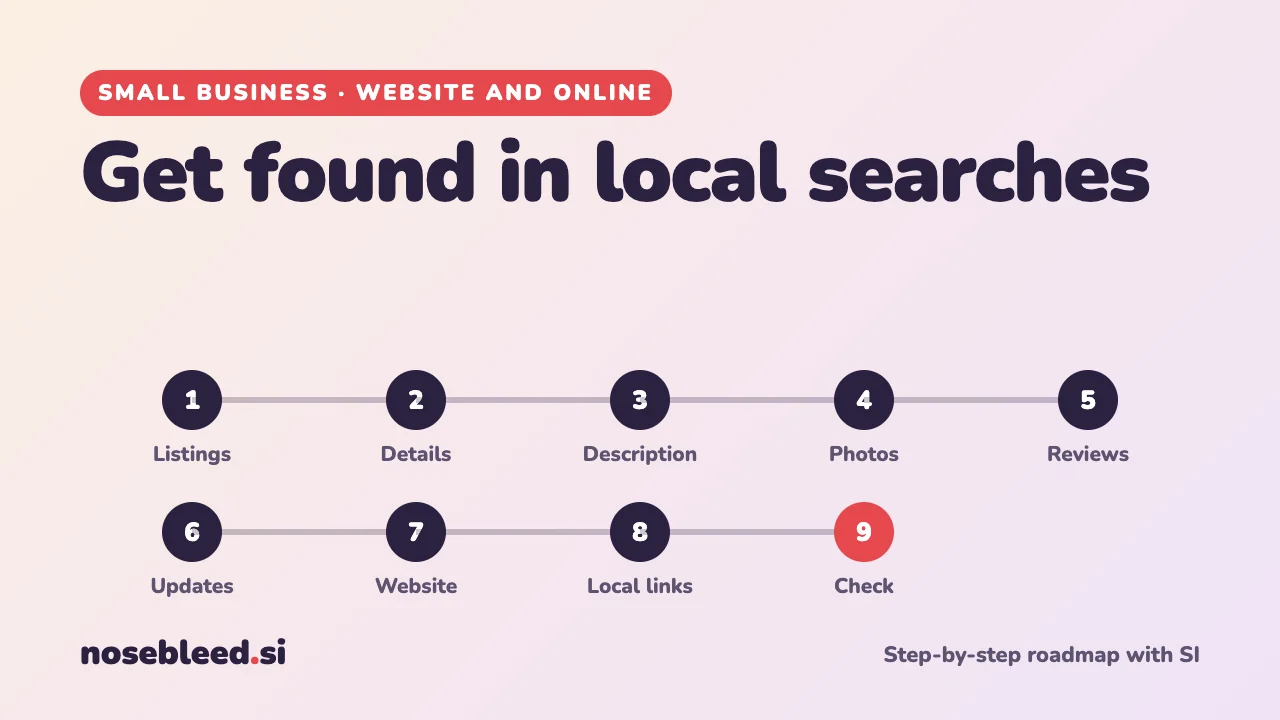
- 🗺️ 9 stages
- ⏱️ A couple of hours to set up, minutes a week after
- 💷 Mostly free
Before you start
Where SI is a great help
- Writing your business description and listing details
- Choosing the words local customers really search for
- Ideas for regular updates and photos
- Explaining confusing settings, step by step
Where you stay in charge
- Setting up and checking the listings yourself.
- Accurate details: hours, address, phone number.
- Real photos and genuine reviews.
- Ignoring anyone who promises a "guaranteed top spot".
Tell SI about your business first
I run a hair salon in Harrogate. My main services are cuts, colour and wedding hair, and I mostly serve customers from the town and nearby villages. I'd like more local people to find me when they search online. Please help me step by step, and ask me anything you need to know first.
The roadmap
Claim your free business listings
When people search for a local business, the map and the list of businesses beside it are filled from free business listings. The main ones are Google Business Profile, Bing Places for Business and Apple Business Connect. Your business may already appear in them, created automatically. Claim it, so you control what it says.
Stage 1 promptExplain, in plain English, how to claim or create a free business listing on Google Business Profile, step by step, including how the business is verified. If you're not sure the steps are still current, say so.
Never pay anyone who calls or emails offering to "verify" or "activate" your listing. The main listings are free.
Get your details exactly right, everywhere
Your business name, address and phone number should be written exactly the same way on every listing, your website and your social media. Add accurate opening hours, including holidays, and the area you serve if you travel to customers.
Stage 2 promptMake me a "master details" sheet for my business listings: every piece of information they usually ask for (name, address, phone, website, hours, holiday hours, services, area served, categories, and so on), with spaces for me to fill in. I'll copy from it every time, so my details always match.
Write a description and choose categories
Describe what you do, where, and what makes you different, in the words customers use. Choose the most accurate main category, such as "Hair salon", and add others only if they're true.
Stage 3 promptWrite a business description for my listing, under 750 characters. Say what I do, where, and what makes me different, using words local customers would search for, naturally, not stuffed in. Then suggest the most accurate main category and up to three extra ones.
Add real photos
Listings with good photos tend to get more attention. Add your shopfront or van, so people recognise you, inside your premises, your work, and you and your team.
Stage 4 promptMake me a list of 12 photos to add to my business listing, in order of importance, with one phone-camera tip for each.
Gather and reply to reviews
Reviews matter a great deal for local searches, both to search engines and to the customers reading them. Ask happy customers for honest reviews, reply to every one, and never use fake or paid-for reviews.
Keep it fresh with updates
Many listings let you post short updates, offers and events. A short update now and then shows customers, and search engines, that you're open and active.
Stage 6 promptSuggest eight short updates I could post on my business listing over the next two months: news, seasonal tips, offers and events. Each under 300 characters, with a photo idea. Leave [gaps] for prices and dates.
Help your website too
If you have a website, make sure each page has a clear title and description that mention what you do and where. If you serve several towns, a short, genuinely useful page for each can help, but never copy the same words with just the town name changed.
Stage 7 promptHere are the pages on my website: [list them]. Write a page title (under 60 characters) and description (under 155 characters) for each, using the words local customers search for, including my town. Then tell me whether I'd benefit from a page for each nearby town I serve, and what would make those pages genuinely useful.
No website yet? See Create a website for your business.
Get known locally, online and off
Mentions and links from other local websites help people find you, and help search engines trust you: your trade association, local business groups, community websites, local news, and events you support.
Stage 8 promptSuggest ten honest ways my business could get mentioned on other local websites: organisations, directories, community groups and events in or near Harrogate. Don't name specific websites you're not sure exist: tell me what kinds to look for instead.
Check what's working
Most business listings show simple figures: how many people saw your listing, and how many called, asked for directions or visited your website. Have a look once a month.
Stage 9 promptHere are my business listing figures for the last three months: [paste or describe them]. Explain what they mean in plain English, what's going well, and two things I could try next month.
Good follow-up questions
Tap a question to copy it. How to take a screenshot
Watch out for
- "Guaranteed first place" offers. Nobody can guarantee a top spot in search results.
- Fake calls about your listing. Callers claiming your listing will be removed unless you pay are usually scams. See Spot scams against business.
- Keyword stuffing. Cramming town names and keywords into your business name or description can get your listing suspended. Use your real business name.
See all our small-business guides
Spotted a mistake? Got a suggestion?
Tell us about this page. It helps us make it better for everyone.
Prefer email? Write to us at hello@nosebleed.si. We read every email, though we can't always reply.
Page ref SB-008 · Page last updated 19 November 2026