
SI (Super Intelligence) and AI (Artificial Intelligence) both mean the same thing when you are doing simple everyday tasks. We mainly use the term SI as that is becoming more commonly used.
Small business · Admin and moneyKeep track of income and expenses
Keep simple, tidy records of the money coming in and going out, in a few minutes a week, so tax time is easy and you always know how you're doing.
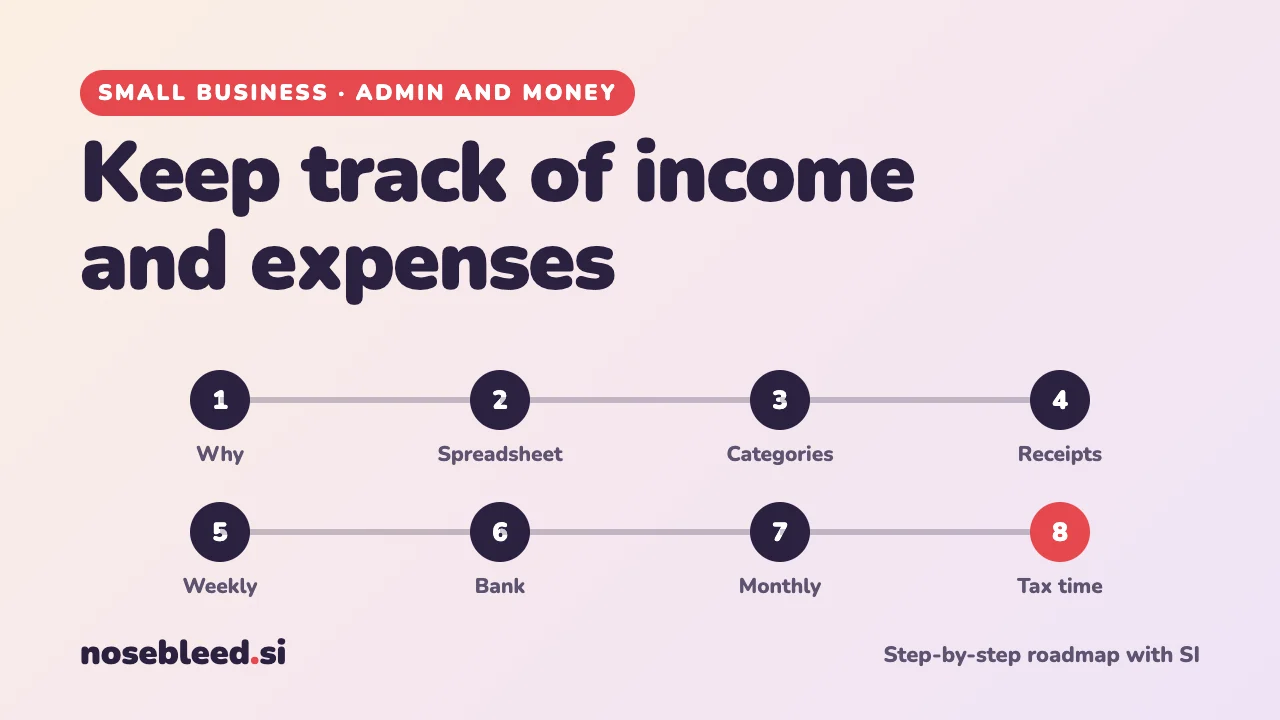
- 🗺️ 8 stages
- ⏱️ An hour to set up, minutes a week after
- 🧾 A spreadsheet, or software if you prefer
Before you start
Where SI is a great help
- Setting up a simple spreadsheet, step by step
- Suggesting categories for your costs
- Explaining spreadsheet formulas
- Making sense of your figures in plain English
Where you stay in charge
- Recording every figure accurately.
- Keeping receipts and invoices safe.
- Checking the tax rules on GOV.UK.
- Tax advice: ask an accountant.
SI can explain and organise, but it isn't a tax adviser, and it may not know the latest rules. This page is general information, not tax advice.
Before you rely on what SI tells you about tax, see Check what SI tells you.
The roadmap
Know why records matter
Good records tell you whether you're making money, help you spot problems early, and make your tax return far easier. In the UK, you must keep records of your business income and expenses, and keep them for a set time.
Stage 1 promptI'm a self-employed gardener in the UK. In plain English, what records of income and expenses should I keep, and why? Tell me where to check the official rules on GOV.UK, including how long to keep them.
Set up a simple spreadsheet
For most small businesses, a spreadsheet with two lists is enough to start: money in and money out. Each line has a date, who it was from or to, what it was for, the amount, and how it was paid.
Stage 2 promptHelp me set up a simple spreadsheet for my business records, step by step, for a beginner. One sheet for money in, one for money out, and a summary sheet with monthly totals. Tell me exactly which columns to add and which formulas to use, and explain each one simply.
New to spreadsheets? See Set up a simple spreadsheet.
Background: spreadsheet or software?
A spreadsheet is free and simple. Bookkeeping software costs a monthly fee, but can link to your bank and do more for you. HMRC is bringing in Making Tax Digital for Income Tax, which means keeping digital records and sending updates using compatible software. It starts with higher incomes and is being phased in. Check GOV.UK whether and when it applies to you.
Choose your categories
Group your expenses into a few clear categories, such as materials, travel, phone, insurance and equipment. It shows where the money goes, and makes your tax return easier.
Stage 3 promptSuggest a short list of expense categories for a business like mine, with examples of what goes in each. Keep them close to the kinds of expenses a UK self-employed tax return asks about, and tell me where to check.
Keep your receipts
Keep every receipt and invoice, paper or digital. A quick phone photo as soon as you get one stops them fading or getting lost. Keep them in one folder per month.
Make it a weekly habit
Ten minutes at the same time each week is far easier than a shoebox of receipts in January. Add the week's money in and money out, and file the receipts.
Stage 5 promptMake me a short weekly checklist for keeping my business records up to date, that takes about ten minutes. Include filing receipts, adding income and expenses, and checking for unpaid invoices.
Check against your bank
Once a month, tick off your records against your bank statement. It catches anything you've missed or entered twice. A separate bank account for the business makes this much easier.
If you ask SI to help with a statement, remove account numbers, and names of customers and suppliers, first. How to hide personal details
Take a look each month
Your totals tell a story: your best and quietest months, costs that are creeping up, and how much you're really making.
Stage 7 promptHere are my monthly totals for money in and money out, by category, for the last six months: [paste them]. In plain English, what do they tell me? What's going well, what should I watch, and what questions should I be asking myself? Use only my figures.
Get ready for tax time
With good records, your tax return is mostly copying totals across. Set aside money for tax as you go, so the bill isn't a shock.
Stage 8 promptI'm getting ready for my first self-employed tax return in the UK. Make me a checklist of what to gather from my records, and a list of questions to ask an accountant or check on GOV.UK. Don't work out my tax for me.
Got a letter from HMRC? See Understand a tax letter.
Good follow-up questions
Tap a question to copy it.
Watch out for
- Tax answers SI isn't sure of. Rules and rates change. Check GOV.UK, or ask an accountant.
- Mixing business and personal money. A separate account keeps records simple.
- Calls or emails "from HMRC" asking for payment or details. They can be scams. See Spot scams against business.
See all our small-business guides
Spotted a mistake? Got a suggestion?
Tell us about this page. It helps us make it better for everyone.
Prefer email? Write to us at hello@nosebleed.si. We read every email, though we can't always reply.
Page ref SB-020 · Page last updated 20 November 2026