
SI (Super Intelligence) and AI (Artificial Intelligence) both mean the same thing when you are doing simple everyday tasks. We mainly use the term SI as that is becoming more commonly used.
Small business · Protect your businessWrite a simple risk assessment
Think through what could cause harm in your business and what to do about it, in plain English, and write it down simply, following the HSE's approach.
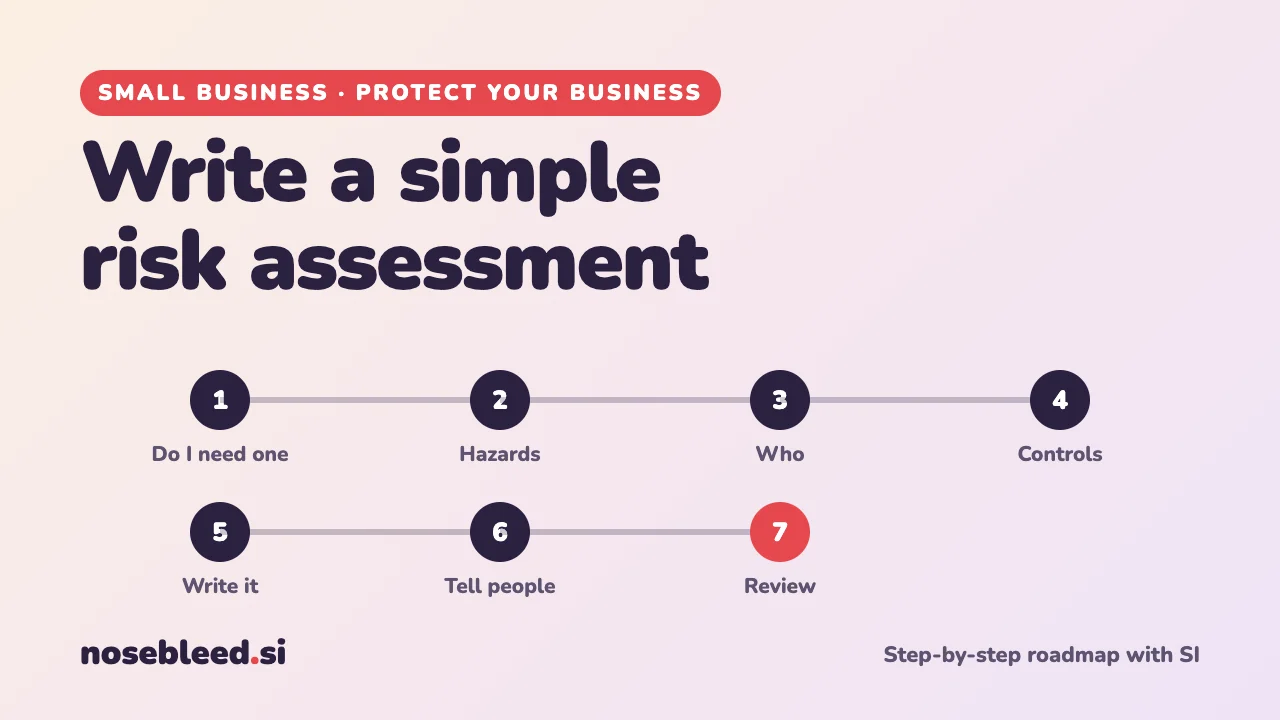
- 🗺️ 7 stages
- ⏱️ An hour or two for most small businesses
- 🦺 Follows the HSE's approach
Why write one?
Sometimes you'll need a risk assessment: the law may require it, or your insurer, a customer or a venue may ask to see one, for example before you work on their premises or at an event.
Even when nobody asks, it's well worth doing. It helps you think through what might go wrong, and how to stop it happening.
Before you start
Where SI is a great help
- Spotting hazards you might not think of
- Suggesting sensible, practical precautions
- Turning your notes into a simple written assessment
- Explaining the guidance in plain English
Where you stay in charge
- Walking round and looking for yourself.
- Checking against the HSE's guidance.
- Actually doing what the assessment says.
- Getting expert help for higher-risk work.
The Health and Safety Executive (HSE) has free, simple guidance for small businesses, including risk assessment templates and examples. This page is general information, not legal advice. Before you rely on what SI tells you, see Check what SI tells you.
The roadmap
Check whether you need one
Employers must assess the risks to their workers and anyone else affected by their work, such as customers and visitors. If you have five or more employees, you must write the main findings down. Some self-employed people whose work poses no risk to others may not need to. The HSE's website explains who needs to do what.
Stage 1 promptI run a small florist's shop with two part-time staff. In plain English, do I need a health and safety risk assessment, and does it need to be written down? Tell me exactly where to check on the HSE's website.
A fire risk assessment is a separate requirement for most business premises. GOV.UK explains the rules, which differ in Scotland.
Spot the hazards
A hazard is anything that could cause harm: slippery floors, sharp tools, chemicals, heavy lifting, electrics, ladders, hot equipment, driving, or working alone. Walk round your workplace and think about everything you and others do.
Stage 2 promptList the hazards likely in a business like mine, room by room and task by task, including less obvious ones such as stress, lone working and display screens. Then give me a checklist to take round my workplace.
Think about who might be harmed, and how
Think about everyone: you, staff, helpers, customers, visitors, delivery drivers, and anyone more at risk, such as young workers, new or expectant mothers, older people or people with disabilities.
Decide what to do about each risk
For each hazard, look at what you already do, then decide whether more is needed. Aim to remove the hazard if you can; if not, reduce the risk with sensible precautions, such as training, guards, safer equipment, or protective clothing.
Stage 4 promptFor each of these hazards in my business: [list them], suggest who might be harmed and how, what precautions are typical, and anything extra I could do. Keep it practical and proportionate for a small business.
Write it down simply
A risk assessment doesn't need to be long. A simple table is enough: the hazard, who might be harmed, what you already do, what more you'll do, who will do it, and by when.
Stage 5 promptFrom everything we've discussed, write my risk assessment as a simple table with columns for: hazard, who might be harmed and how, what I'm already doing, what more I need to do, who does it, and by when. Plain English. Mark anything I should check with the HSE with [CHECK].
Compare yours with the HSE's free template and example risk assessments for businesses like yours.
Tell people and do it
A risk assessment only works if people know about it and the precautions really happen. Talk it through with staff and helpers, and ask what they think: they often spot things you miss.
Stage 6 promptWrite a short, friendly summary of my risk assessment for staff and helpers: the main risks, what we do about each, and who to tell if something's wrong. One page, easy to read.
See also Write simple procedures and checklists.
Review it
Look at it again whenever something changes, such as new equipment, a new task, a new member of staff, or after an accident or near miss, and at least once a year anyway.
Good follow-up questions
Tap a question to copy it.
Watch out for
- A copied template that doesn't fit. Your assessment must be about your own workplace and work.
- Paperwork without action. The point is to keep people safe, not to file a form.
- Higher-risk work. Gas, electrics, asbestos, heights and hazardous substances have specific rules. Take expert advice.
See all our small-business guides
Spotted a mistake? Got a suggestion?
Tell us about this page. It helps us make it better for everyone.
Prefer email? Write to us at hello@nosebleed.si. We read every email, though we can't always reply.
Page ref SB-036 · Page last updated 21 November 2026