
SI (Super Intelligence) and AI (Artificial Intelligence) both mean the same thing when you are doing simple everyday tasks. We mainly use the term SI as that is becoming more commonly used.
Small business · Staff, helpers and suppliersWrite simple procedures and checklists
Get the way you do things out of your head and onto paper, so helpers, staff, or a stand-in can do them well, and nothing gets forgotten.
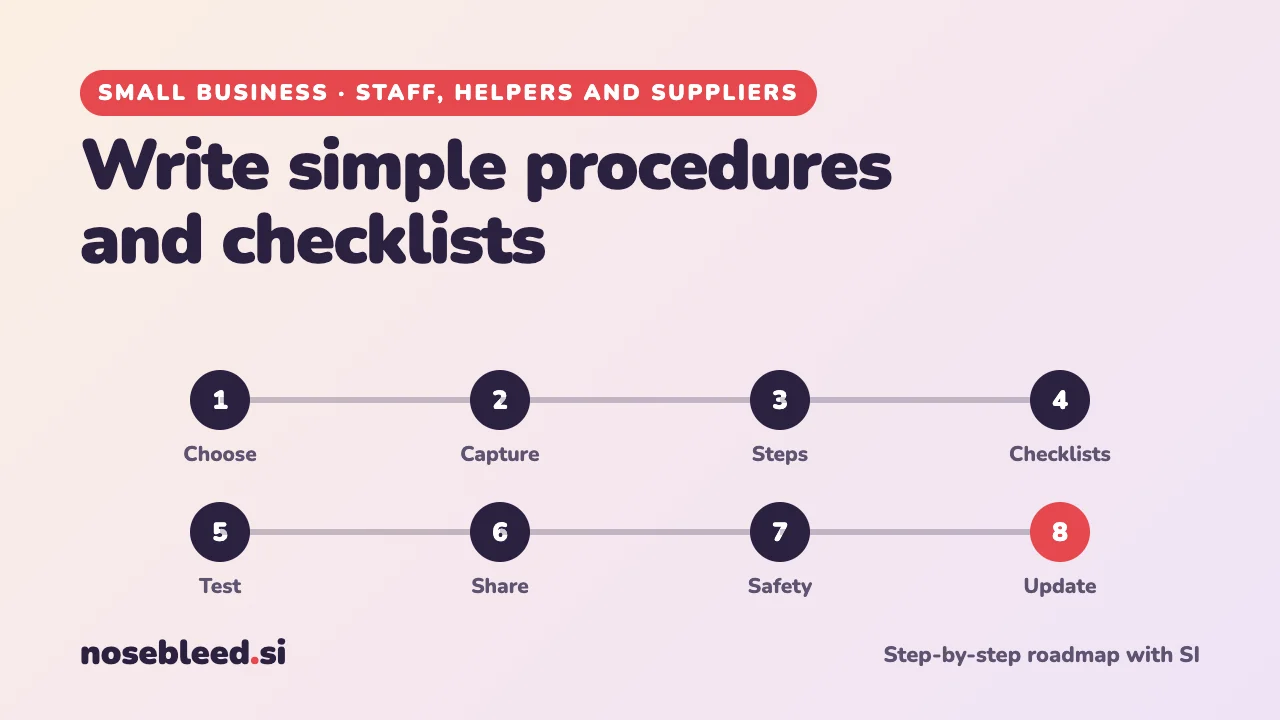
- 🗺️ 8 stages
- ⏱️ Half an hour per procedure
- 📋 For helpers, staff, family and you
Before you start
Where SI is a great help
- Turning a rambling explanation into clear steps
- Spotting steps you've missed
- Checklists, short versions and printable layouts
- Simpler wording for new helpers
Where you stay in charge
- How things are really done in your business.
- Safety steps: check them carefully.
- Keeping passwords and personal details out.
- Testing every procedure with a real person.
Written procedures help when you take on a helper, go on holiday, or are suddenly unable to work. They also help you notice ways to do things better.
The roadmap
Choose what to write down first
Start with the jobs that matter most if they go wrong, the ones you repeat often, and the ones only you know how to do.
Stage 1 promptI run a small café with two part-time helpers. Help me list the everyday tasks and jobs that would most benefit from a written procedure or checklist, such as opening up, closing, cleaning, taking deliveries and handling money. Put them in order: most important first.
Capture how you really do it
The easiest way is to talk it through. Describe the job as you do it, in your own words, by typing or by speaking to SI. Don't worry about being tidy.
Stage 2 promptI'm going to describe how I close the café at the end of the day, in my own words. Listen, then ask me questions about anything unclear or anything I might have missed. Don't write the procedure yet.
Speaking is often quicker than typing. How to speak instead of typing
Turn it into clear steps
Good procedures have numbered steps, one action per step, in the order they're done, with a note of why for anything that isn't obvious.
Stage 3 promptNow write it as a clear procedure: a title, what it's for, what's needed, then numbered steps with one action each, in plain English for someone new. Add a short reason for any step that might seem odd, and mark anything I should double-check with [CHECK].
Make a checklist version
Once someone knows a job, a short checklist is all they need: something to tick off, pinned up where the job is done.
Stage 4 promptTurn this procedure into a one-page checklist with tick boxes, short enough to pin on a wall. Put anything to do with safety or money in bold. [paste the procedure]
Test it with someone else
Ask someone who doesn't usually do the job to follow it, while you watch without helping. Wherever they hesitate, the procedure needs fixing.
Stage 5 promptMy helper tested this procedure. They got stuck at [where and why]. Improve the procedure so that part is clear, without making it much longer. [paste the procedure]
Keep them where people can find them
Keep all your procedures in one place: a folder, a shared document, or printed in a binder. Pin checklists where the work happens. Tell everyone where they are.
Never put passwords in a procedure. Say where they're kept instead, and keep them safe.
Check the safety steps
If a job involves anything that could hurt someone, such as hot equipment, chemicals, lifting, ladders or food hygiene, make sure the safety steps are clear, correct and can't be skipped. SI can help word them, but check them against official guidance.
The Health and Safety Executive (HSE) has free, simple guidance for small businesses. Food businesses can also find guidance from the Food Standards Agency. See also Write a simple risk assessment.
Keep them up to date
Whenever you change how something's done, update the procedure straight away. Once a year, read through them all and remove anything out of date.
Stage 8 promptI've changed how we take card payments: [what's changed]. Update this procedure and checklist to match, and tell me what else in my other procedures might need changing too. [paste the procedure]
Good follow-up questions
Tap a question to copy it. If you're suddenly unable to work, see stage 5 of Plan for when things go wrong.
What a good answer looks like
Closing up: checklist
- ☐ Turn the "Open" sign to "Closed" at [time]
- ☐ Switch off and unplug the coffee machine and grill
- ☐ Put food away, labelled and dated
- ☐ Wipe down counters and tables
- ☐ Count the till and put the cash in [place]
- ☐ Lock the back door, then the front
Why it's good: short, in order, one action per line, with safety and money steps in bold. The [gaps] are for your own details.
See all our small-business guides
Spotted a mistake? Got a suggestion?
Tell us about this page. It helps us make it better for everyone.
Prefer email? Write to us at hello@nosebleed.si. We read every email, though we can't always reply.
Page ref SB-030 · Page last updated 21 November 2026