
SI (Super Intelligence) and AI (Artificial Intelligence) both mean the same thing when you are doing simple everyday tasks. We mainly use the term SI as that is becoming more commonly used.
Small business · Admin and moneyOrganise your week
Get on top of a busy week, with a simple weekly plan that puts the important jobs first and leaves time for you.
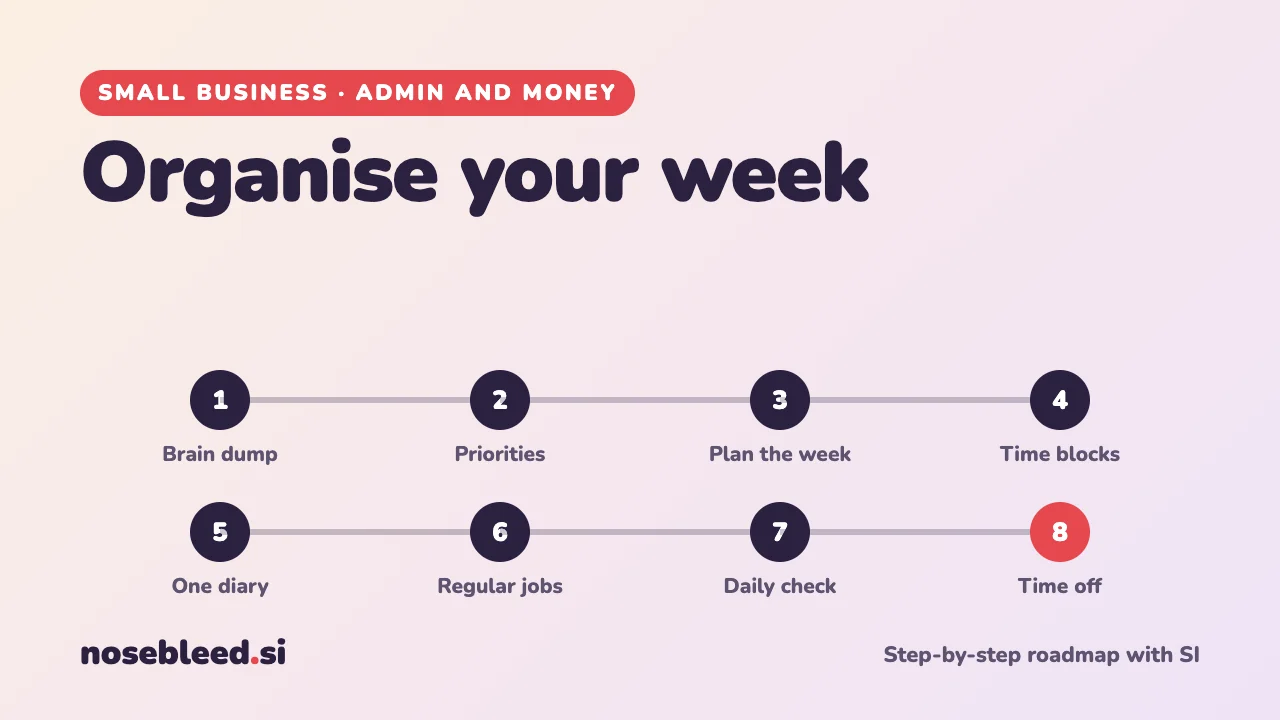
- 🗺️ 8 stages
- ⏱️ 20 minutes each week
- 🗓️ Paper, phone or computer
Before you start
Where SI is a great help
- Turning a messy list into a clear plan
- Helping you decide what matters most
- Suggesting a realistic weekly routine
- Explaining calendar and reminder features
Where you stay in charge
- What really matters this week.
- How much you can realistically do.
- Keeping customers' details out of SI chats.
- Time for yourself and your family.
There's no single right system. The best one is simple enough that you'll still be using it in a month.
The roadmap
Get everything out of your head
Write down every job, call, task and worry, big or small, in any order. Getting it out of your head is a relief in itself.
Stage 1 promptHere's everything I need to do, in no particular order: [type or speak it all out, with no customer names]. Sort it into groups, such as customer jobs, admin, money, marketing and personal, and tell me if anything looks urgent.
Speaking can be quicker than typing. How to speak instead of typing
Decide what matters most
Not everything is equally important. Put first the jobs that earn money, keep customers happy, have a deadline, or will cause trouble if they slip.
Stage 2 promptHelp me sort my list into: must do this week, should do this week, could wait, and could drop or hand to someone else. Ask me about anything you're not sure of.
Plan the week
Spend 20 minutes at the same time each week, such as Friday afternoon or Monday morning, putting your must-dos into the days. Be realistic: plan for interruptions.
Stage 3 promptI work Monday to Friday, 8am to 4pm, plus Saturday mornings. These are already fixed: [bookings and appointments, with no names]. Fit my must-do and should-do jobs around them in a realistic weekly plan, leaving some spare time for the unexpected.
Block out time for similar jobs
Doing similar jobs together saves time: all your calls in one slot, admin in another, emails twice a day rather than all day.
Stage 4 promptSuggest a simple weekly routine for a business like mine, with regular slots for customer work, admin, money, marketing, and emails. Keep it flexible and realistic for one person.
Keep one diary
Keep all your bookings, appointments and deadlines in one place: a paper diary or one calendar on your phone. Two diaries lead to double bookings.
Stage 5 promptI use the calendar on my phone. Explain step by step how to add appointments with reminders, set up jobs that repeat, and see my whole week at a glance. If you're not sure the steps are current for my phone, say so.
Make regular jobs automatic
Some jobs come round every week or month: invoices, records, ordering, social media posts. Put them in your diary as repeating reminders, so you don't have to remember them.
Stage 6 promptList the regular weekly, monthly and yearly jobs a business like mine usually has, such as invoicing, records, tax dates and insurance renewals, so I can add them to my diary as reminders.
See also Write invoices and chase late payment and Keep track of income and expenses.
Check in each day
Five minutes at the start or end of each day: what are the three most important things for tomorrow? Move anything that didn't get done.
Stage 7 promptHere's what I planned today and what actually got done: [list]. Help me rearrange the rest of my week, and pick my three most important jobs for tomorrow.
Protect your time off
Running a small business can take over your life. Put time off in the diary first, and treat it like a booking. Set clear hours, and let customers know when you're available.
Stage 8 promptI'm finding it hard to switch off from my business. Suggest five practical ways to protect my evenings and weekends, and write a friendly line for my website and email signature that sets out my working hours.
See also Write email templates, including an "away" message.
Good follow-up questions
Tap a question to copy it.
Watch out for
- Planning every minute. Leave space for the unexpected, because it always happens.
- Too many lists and apps. One list and one diary is enough.
- Customers' details in SI chats. Use "Customer A" or "the kitchen job" instead of names and addresses.
See all our small-business guides
Spotted a mistake? Got a suggestion?
Tell us about this page. It helps us make it better for everyone.
Prefer email? Write to us at hello@nosebleed.si. We read every email, though we can't always reply.
Page ref SB-038 · Page last updated 21 November 2026