
SI (Super Intelligence) and AI (Artificial Intelligence) both mean the same thing when you are doing simple everyday tasks. We mainly use the term SI as that is becoming more commonly used.
Small business · MarketingWrite an advert
Write a clear, honest advert that reaches the right people and brings in customers, and find out whether it's worth the money.
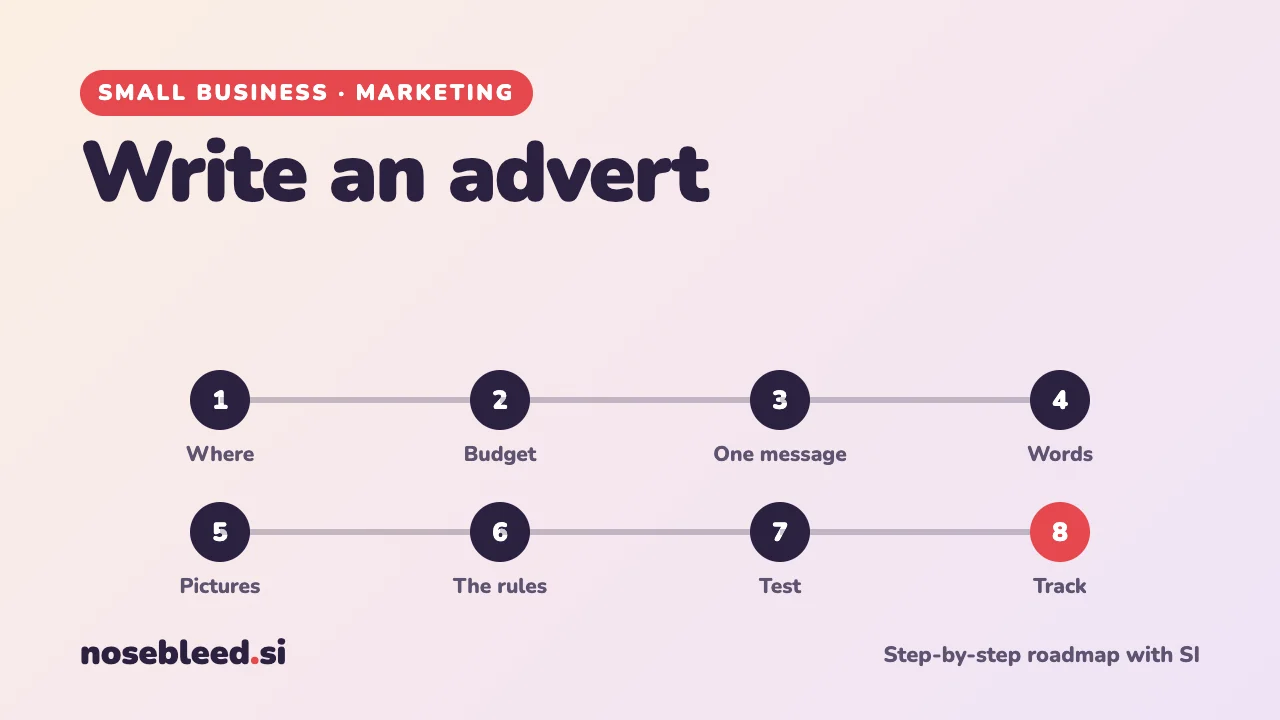
- 🗺️ 8 stages
- ⏱️ An evening per advert
- 📢 Print, online and community magazines
Before you start
Where SI is a great help
- Short, punchy headlines and wording
- Different versions to test
- Pictures in your style
- Checking your claims before you pay
Where you stay in charge
- How much you spend, and where.
- Every price, claim and contact detail.
- Only claims you can prove.
- Deciding whether it's worth repeating.
In the UK, adverts must be legal, decent, honest and truthful. The Advertising Standards Authority (ASA) has free guidance for small businesses. This page is general information, not legal advice. Before you rely on what SI tells you, see Check what SI tells you.
Tell SI about your business first
I run a small window cleaning business covering a few villages. My best customers are homeowners, often retired. I'd like to try advertising, with a budget of about £100 a month. Please help me step by step, and ask me anything you need to know first.
The roadmap
Choose where to advertise
Go where your customers already look: a community or parish magazine, a local paper, a club programme, a noticeboard, or online adverts on search engines and social media, which can be aimed at people in your area.
Stage 1 promptFor a business like mine and customers like mine, compare the main places I could advertise: community magazines, local papers, noticeboards, and online adverts on search and social media. For each, say who it reaches, rough costs, and pros and cons. If you're not sure of current costs, say so.
Set a budget, and a test period
Decide what you can afford to spend without it hurting, and for how long, such as three months. Work out how many new customers you'd need to cover the cost.
Stage 2 promptIf I spend £100 a month on adverts, and a new customer is worth about £25 a visit, often coming back every month, how many new customers do I need for it to be worth it? Explain simply, using only my figures.
Pick one clear message
An advert has a few seconds to catch someone's eye. Choose one main message: the problem you solve, what makes you different, or an offer. Don't try to say everything.
Stage 3 promptAsk me three questions about why customers choose me. Then suggest five possible main messages for my advert, and say which one would most likely make my kind of customer get in touch.
Write the words
A strong headline, a line or two of detail, and a clear way to get in touch. For print, make the phone number big. For online adverts, keep within the word limits.
Stage 4 promptWrite three versions of my advert for a quarter-page in a community magazine: a headline, two short lines, and a clear "get in touch" line with [gaps] for my details. Make each version different in approach. Plain English, no exaggeration.
Add a picture
A real photo of you or your work usually beats a generic image. If you use an SI image tool, keep the style consistent with your other materials, and check any lettering carefully.
See Take better product photos and Choose your brand colours and style.
Keep it within the rules
In general, in the UK:
- Every claim must be true, and you must be able to prove it. "Cheapest in the area" or "number one" need evidence.
- Prices and offers must be clear, including any conditions.
- Adverts must be obviously adverts. On social media, paid or promotional posts should be clearly labelled as ads.
- Reviews and testimonials must be real. Fake reviews are banned.
Stage 6 promptCheck my advert for any claim that might be misleading or that I'd need to prove, any unclear price or offer, and anything else that might break UK advertising rules. Suggest safer wording, and tell me what to check on the ASA's website. [paste the advert]
Test different versions
Online adverts make it easy to try two versions side by side and see which works better. In print, try a different version each month, or in different magazines.
Stage 7 promptExplain simply how I could test two versions of my advert, online and in print, so I can tell which one works better. Keep it practical for a very small business.
Track what works
Ask every new customer how they heard about you, and write it down. A different offer code or phone message for each advert helps too. After your test period, keep what works, and stop what doesn't.
Stage 8 promptOver three months I spent [amount] on adverts in [where], and got [number] new customers from them. Was it worth it? What should I keep, change or stop? Use only my figures.
Good follow-up questions
Tap a question to copy it.
Watch out for
- Claims you can't prove. "Best", "cheapest" and "guaranteed" need evidence.
- Online adverts running up costs. Set a daily or monthly limit before you start.
- Pushy sales calls. If someone calls offering advertising, take time to check who they are and what you'd really get before agreeing to anything.
See all our small-business guides
Spotted a mistake? Got a suggestion?
Tell us about this page. It helps us make it better for everyone.
Prefer email? Write to us at hello@nosebleed.si. We read every email, though we can't always reply.
Page ref SB-044 · Page last updated 22 November 2026