
SI (Super Intelligence) and AI (Artificial Intelligence) both mean the same thing when you are doing simple everyday tasks. We mainly use the term SI as that is becoming more commonly used.
Small business · Brand and designChoose your brand colours and style
Give your business a simple, consistent look and voice, so everything you make looks like it comes from the same place, and customers recognise you.
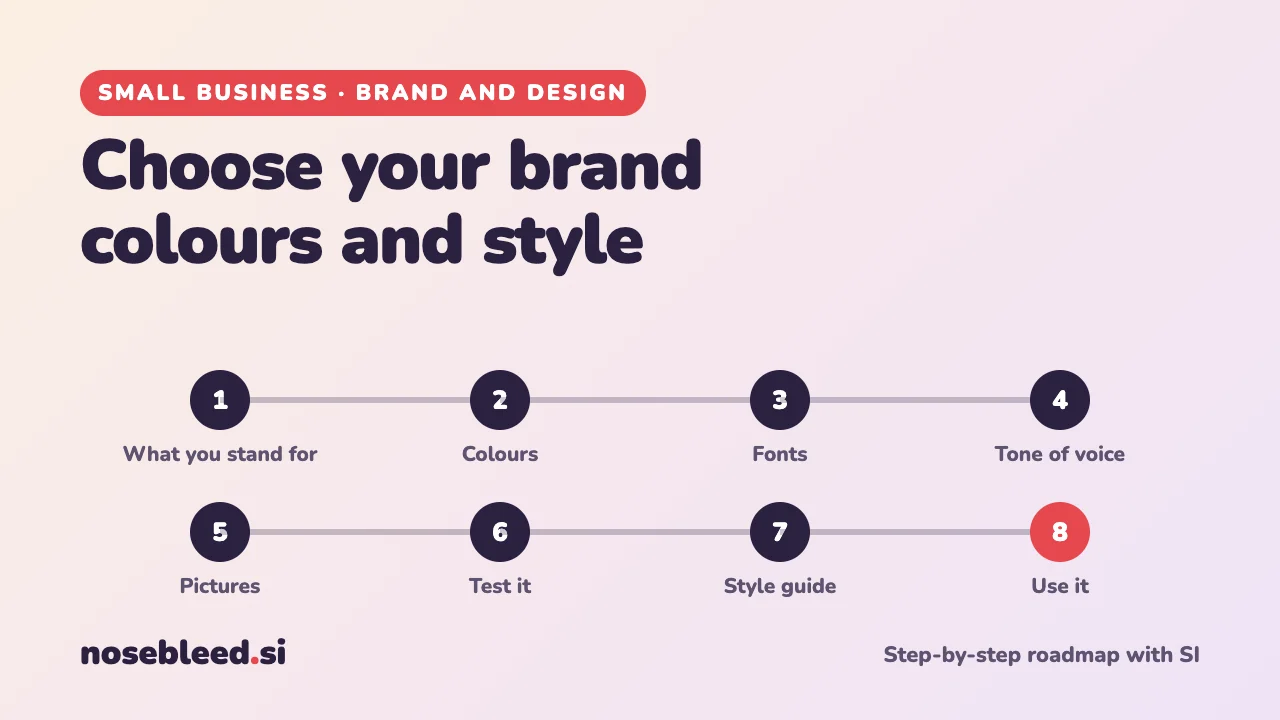
- 🗺️ 8 stages
- ⏱️ An evening or two
- 🎨 A one-page style guide to keep
Have these ready first
Your colours and style work best alongside your name and logo. Often the colours come straight from the logo. If you haven't settled those yet, start here:
Before you start
Where SI is a great help
- Suggesting colour combinations that work together
- Matching fonts to the feel of your business
- Describing your tone of voice, with examples
- Putting it all on one simple page
Where you stay in charge
- What feels right for you and your customers.
- Checking colours look right on screen and in print.
- Making sure text is easy to read.
- Sticking to it once you've decided.
"Brand" just means how your business looks, sounds and feels to customers. You don't need a designer or an agency to get this right. SI can help you make a simple, sensible set of choices in an evening.
Tell SI about your business first
I run a small dog grooming business in a seaside town. My customers are mostly local families and older dog owners. I'd like to choose a simple set of colours, fonts and a tone of voice so everything I make looks and sounds consistent. Please help me step by step, and ask me anything you need to know first.
The roadmap
Decide what you want to stand for
Before choosing colours, pick three or four words that describe how you want customers to feel about your business: for example friendly, calm, expert, traditional, bold or fun.
Stage 1 promptAsk me five questions, one at a time, about my business, my customers and what makes me different. Then suggest four words that sum up how my business should look and feel, and explain why.
Choose your colours
Most small businesses need just two or three colours: a main colour, a second colour that goes with it, and a neutral one, such as white, cream or dark grey, for backgrounds and text. If you have a logo, start with its colours.
Stage 2 promptSuggest three colour schemes for my business, each with a main colour, a second colour and a neutral. For each, give the colour codes (hex, and RGB) and say what feeling it gives. Make sure dark text on the light colours, or light text on the dark ones, is easy to read.
Colour codes like #2A6F97 make sure your colours are exactly the same on your website, signs and printing. Keep a note of them.
Pick one or two fonts
Choose one font for headings and, if you like, a second for everyday text. Clear, simple fonts are easiest to read, especially for older customers and on small screens.
Stage 3 promptSuggest three pairs of fonts for my business: one for headings and one for everyday text. Choose fonts that are free to use in business, easy to read, and widely available in design apps and on websites. Say where I can check each font's licence.
Not every font is free for business use. Check the licence before you use one on signs, printing or your website.
Choose your tone of voice
Your tone of voice is how your business sounds in writing: on your website, in emails and on social media. Friendly or formal? Chatty or brief? Decide once, so everything sounds like you.
Stage 4 promptDescribe a tone of voice for my business in three short rules, with a "do this" and "not this" example for each. Then rewrite this sentence in that tone: "We are open Monday to Saturday and appointments can be booked by phone."
Decide the style of your pictures
Choose a picture style and stick to it: for example bright, natural daylight photos of your real work, or simple illustrations in your colours. A consistent style makes everything look more professional.
Stage 5 promptSuggest a simple picture style for my business: the kind of photos or illustrations, the lighting, the backgrounds, and what to avoid. Write it as three short rules I can follow whenever I take a photo or make an image.
Test it before you decide
Try your colours, fonts and logo together on a few real things, such as a business card, a social media post and your website's top section. Look at them on your phone, and print one out.
Stage 6 promptI've attached a mock-up using my colours and fonts. Is it easy to read? Do the colours work together, and do they suit the four words we chose? Is there enough contrast for someone with poor eyesight? Suggest any changes.
How to attach a picture. Ask a few customers or friends what they think too.
Put it all on one page
A one-page style guide keeps everything in one place: your logo, colour codes, fonts, tone of voice and picture style. It's useful for you, and for anyone who helps you, such as a printer, sign maker or helper.
Stage 7 promptFrom everything we've decided, write my one-page style guide: the four words, my colours with their codes, my fonts and where to use each, my tone of voice rules with examples, and my picture style. Plain English, easy to follow.
Use it everywhere
Consistency is what makes customers recognise you. Use the same colours, fonts and tone on your website, social media, emails, cards, signs, invoices and van. Update old things gradually as you reorder them.
Make business cards and leaflets Make signs, posters and menus
Good follow-up questions
Tap a question to copy it.
Watch out for
- Too many colours and fonts. Two or three colours and one or two fonts is plenty.
- Text that's hard to read. Pale text on a pale background, or fancy fonts, can put customers off. Choose clear contrast.
- Copying another business. Avoid a look that could be confused with a competitor or a well-known brand.
See all our small-business guides
Spotted a mistake? Got a suggestion?
Tell us about this page. It helps us make it better for everyone.
Prefer email? Write to us at hello@nosebleed.si. We read every email, though we can't always reply.
Page ref SB-040 · Page last updated 21 November 2026