
SI (Super Intelligence) and AI (Artificial Intelligence) both mean the same thing when you are doing simple everyday tasks. We mainly use the term SI as that is becoming more commonly used.
Small business · Brand and designMake signs, posters and menus
Make clear, eye-catching signs, posters and menus that people can read at a glance, and get the important details right.
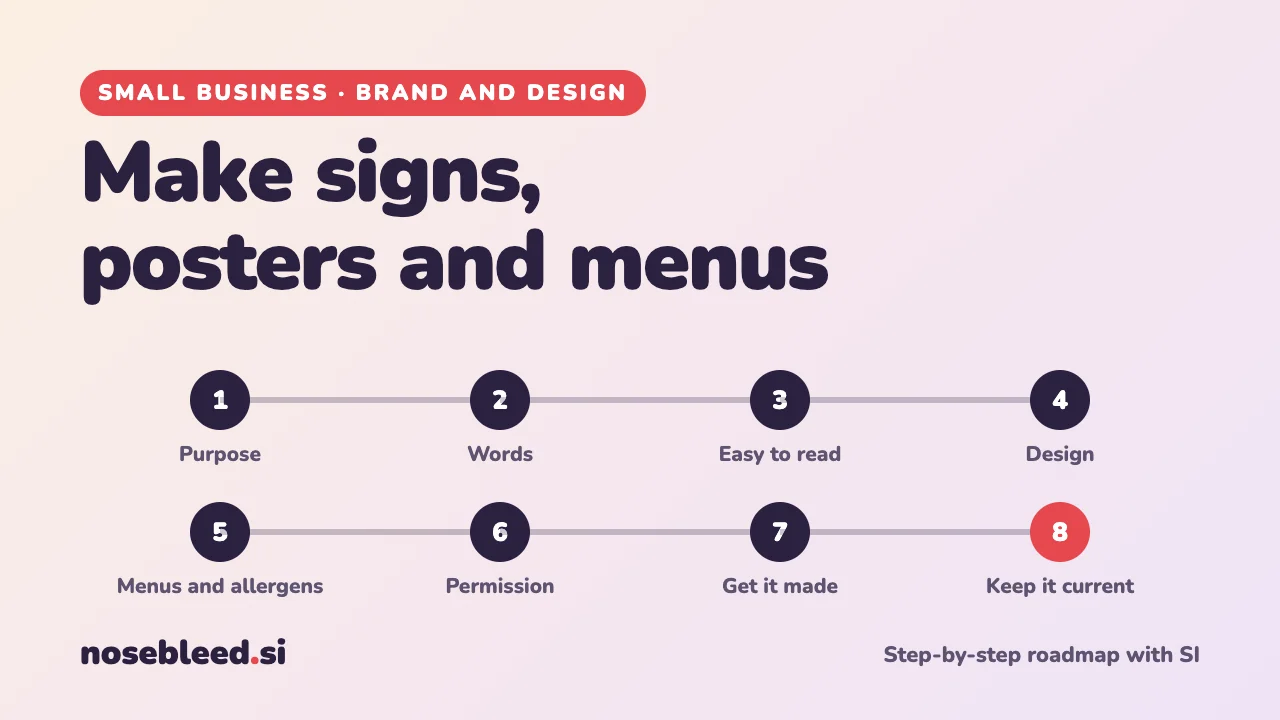
- 🗺️ 8 stages
- ⏱️ An evening per design
- 🪧 Shop, stall, café, van or event
Have these ready first
Signs, posters and menus are quicker to make, and look more professional, once you've settled your logo, colours and style. If you haven't yet, start here:
Design a logo Choose your brand colours and style Make business cards and leaflets
Before you start
Where SI is a great help
- Short, clear words that work at a glance
- Tempting descriptions for menus and price lists
- Layout ideas and pictures in your style
- Checking your design before it's made
Where you stay in charge
- Prices, opening times and contact details.
- Allergen information: it must be accurate.
- Checking whether a sign needs permission.
- The final check before anything is made.
This page is general information for the UK, not legal advice. Before you rely on what SI tells you, see Check what SI tells you.
Tell SI about your business first
I run a small café on a busy high street. I need a new menu, a price board and a window poster for our weekend breakfasts. My customers are mostly shoppers, families and office workers. Please help me step by step, and ask me anything you need to know first.
The roadmap
Decide what each one needs to do
A shop sign tells people who you are and what you do, from across the street. A poster gets one message across quickly, such as an offer or an event. A menu or price list helps people choose and order easily.
Stage 1 promptFor my business, what should my shop sign, window poster and menu each achieve? Who will see them, from how far away, and how long will they look? What one thing should each make people do?
Write the words
Fewer words work better. A sign needs your name and what you do. A poster needs one big message, the key details, and what to do next. A menu needs clear names, short tempting descriptions, and prices.
Stage 2 promptWrite the words for a window poster about our new weekend breakfasts, served 8am to 11.30am: a big heading of no more than six words, two or three short lines of detail, and a clear "come in" line. Then write short, tempting menu descriptions for these dishes: [list them]. Plain English, no exaggeration.
Make it easy to read
People often read signs and posters from a distance or in passing. Use large, clear letters, strong contrast between text and background, and plenty of space. Keep menus easy to read for older customers and in dim light.
Stage 3 promptHow big should the letters be on a shop sign read from across the road, an A3 window poster, and an A4 menu? Which colour combinations are easiest to read? Explain simply.
Plan the design
Use your logo, colours and fonts so everything matches. Make the most important thing biggest. Design apps have ready-made templates for posters and menus that SI can help you adapt.
Stage 4 promptDescribe three simple layouts for my A4 menu: how to group the dishes, where prices go, where the allergen note goes, and how to use my colours [colour codes]. Keep it uncluttered and easy to scan.
If an SI image tool makes a picture for your poster, check any lettering carefully, or add the words yourself in your design app.
Get allergen information right on menus
If you serve food, you must be able to tell customers which of the 14 main allergens are in your dishes, such as milk, eggs, gluten, nuts and sesame. Many businesses add a clear note to the menu, such as "Please ask us about allergens". Food you make and pack on the premises before it's ordered has extra labelling rules.
Stage 5 promptHere are my dishes and their ingredients: [list them]. Make me a simple allergen chart showing which of the UK's 14 main allergens each dish contains. Mark anything you're unsure of with [CHECK], and tell me where to check the official guidance.
The Food Standards Agency has free guidance and allergen templates. Always check SI's allergen chart against your actual ingredients and labels: a mistake could make someone seriously ill.
Check whether you need permission
Some signs need permission from your council, called advertisement consent, especially larger or illuminated signs, or signs on listed buildings or in conservation areas. Putting an A-board on the pavement may need a council licence too. If you rent, check your lease and ask your landlord.
Stage 6 promptI'd like to put up a new sign above my shop and an A-board on the pavement in England. In plain English, what permissions might I need, and exactly where should I check with my council and on GOV.UK? Mark anything you're unsure is current.
The rules differ in Scotland, Wales and Northern Ireland. Your council's planning team can tell you what applies to you.
Get it made
Print posters and menus at home or with a printer. For a permanent shop sign, a local sign maker can advise on materials and fitting. Check every detail on the final proof before you approve it.
Stage 7 promptI've attached my poster design. Check it like a careful proofreader: spelling, prices, times, anything hard to read from a distance, and whether it's clear what to do next. Then list the questions I should ask a printer or sign maker.
How to attach a file. For printing terms explained, see Make business cards and leaflets.
Keep it up to date
Out-of-date prices, old offers and wrong opening times annoy customers. Take posters down when an offer ends, and update menus and price lists whenever things change. Keep the design file, so changes are quick.
Stage 8 promptMy prices have changed: [list the changes]. Update my menu text, keep the same style, and list every place I need to change these prices, such as my website, social media and price board.
Good follow-up questions
Tap a question to copy it.
Watch out for
- Allergen mistakes. Check every dish against your real ingredients and labels, and update the chart whenever a recipe or supplier changes.
- Spelling mistakes in SI images. Check every letter, or add the words yourself.
- Putting up a sign without checking. Some signs need permission. Check with your council first.
See all our small-business guides
Spotted a mistake? Got a suggestion?
Tell us about this page. It helps us make it better for everyone.
Prefer email? Write to us at hello@nosebleed.si. We read every email, though we can't always reply.
Page ref SB-042 · Page last updated 21 November 2026