
SI (Super Intelligence) and AI (Artificial Intelligence) both mean the same thing when you are doing simple everyday tasks. We mainly use the term SI as that is becoming more commonly used.
Small business · Brand and designWrite your business story
Write a warm, honest "About us" story in your own voice, so customers get to know the real people behind your business and choose you.
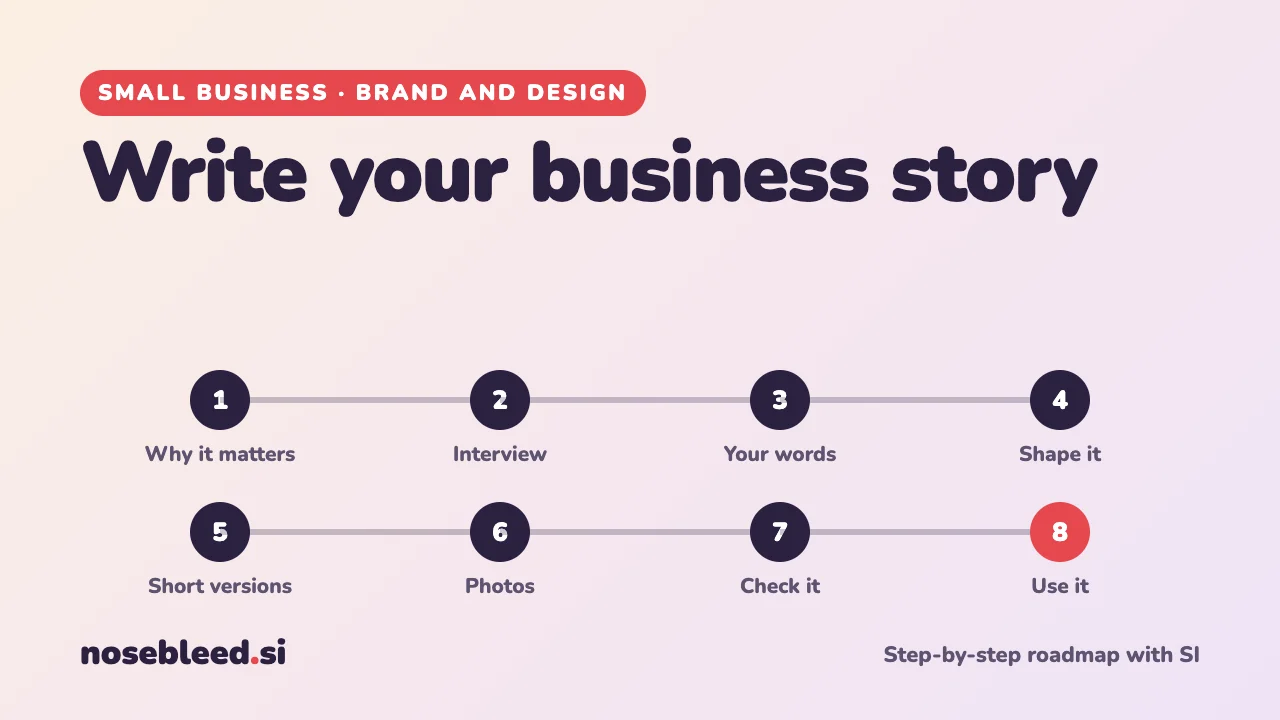
- 🗺️ 8 stages
- ⏱️ An evening
- ✍️ For your website, leaflets and social media
Before you start
Where SI is a great help
- Asking good questions to draw out your story
- Shaping your answers into a clear story
- Short versions for social media and leaflets
- Checking it reads well
Where you stay in charge
- Every fact, date and detail: it must be true.
- Your voice: it should sound like you.
- What you're happy to share about yourself.
- Permission from anyone you mention.
Customers often read the "About us" page before they get in touch. A real, honest story about who you are and why you do it builds trust in a way no advert can.
Tell SI about your business first
I run a small family bakery in a village. I'd like to write an honest, warm "About us" story for my website, in my own voice. Please help me step by step. Start by interviewing me, one question at a time, and don't add anything I haven't told you.
The roadmap
Know why it matters
A good business story answers the questions customers quietly ask: who are you, why do you do this, and why should I trust you? It's not your CV, and it's not a sales pitch.
Let SI interview you
Talking is easier than writing. Let SI ask the questions, and answer as if chatting to a friend. Speaking your answers can be even quicker.
Stage 2 promptInterview me about my business, one question at a time, like a friendly local journalist. Ask about how I started, why I do it, what I care about, what makes my business different, and a moment I'm proud of. Ask a follow-up question if an answer is interesting.
Keep it in your own words
Your story should sound like you, not like a brochure. Ask SI to use your words and phrases, and not to add anything you didn't say.
Stage 3 promptFrom my answers, write my "About us" story in about 250 words. Use my own words and phrases wherever you can, keep my way of speaking, and don't add any facts, claims or feelings I didn't mention. Mark anything you're unsure of with [CHECK].
Shape the story
A simple shape works well: how it started, what you do now and who for, what you care about, and a warm invitation to get in touch. Lead with the most interesting part.
Stage 4 promptLook at my story. Is the most interesting part near the start? Does it end with a friendly invitation to get in touch? Suggest a better opening line and a better ending, using only what I've told you.
Make short versions
You'll need shorter versions for social media profiles, leaflets, directories and talks: one sentence, about 50 words, and about 100 words.
Stage 5 promptFrom my "About us" story, write three shorter versions: one sentence for a social media profile, about 50 words for a leaflet or directory listing, and about 100 words for an introduction. Keep my voice and only my facts.
Add a real photo
A friendly photo of you, your team or your workplace makes the story real. Stock photos of strangers have the opposite effect.
See Take better product photos. The same tips work for photos of people.
Check it's true and fair
Read it aloud. Does it sound like you? Is every fact right? Only include customer comments if they're real and you have permission to use them, and only mention other people if they're happy to be included.
Stage 7 promptRead my story as a customer would. Does anything sound exaggerated, boastful or vague? Point out any claims I should be able to back up, and suggest plainer wording.
Use it everywhere
Put the full story on your website's "About us" page, and the short versions on your social media, leaflets and business listings. Update it as your business grows.
Improve the words on an existing website Create a website for your business
Good follow-up questions
Tap a question to copy it.
Watch out for
- Details SI makes up. SI may add a nice-sounding detail that isn't true. Remove anything you didn't say.
- Made-up quotes or reviews. Only use real customer words, with their permission.
- Too much about you, not enough about customers. Make sure it says what you do for them.
See all our small-business guides
Spotted a mistake? Got a suggestion?
Tell us about this page. It helps us make it better for everyone.
Prefer email? Write to us at hello@nosebleed.si. We read every email, though we can't always reply.
Page ref SB-041 · Page last updated 21 November 2026