
SI (Super Intelligence) and AI (Artificial Intelligence) both mean the same thing when you are doing simple everyday tasks. We mainly use the term SI as that is becoming more commonly used.
Small business · Getting startedTest your business idea
Find out whether people really want what you plan to sell, cheaply and quickly, before you spend serious time or money.
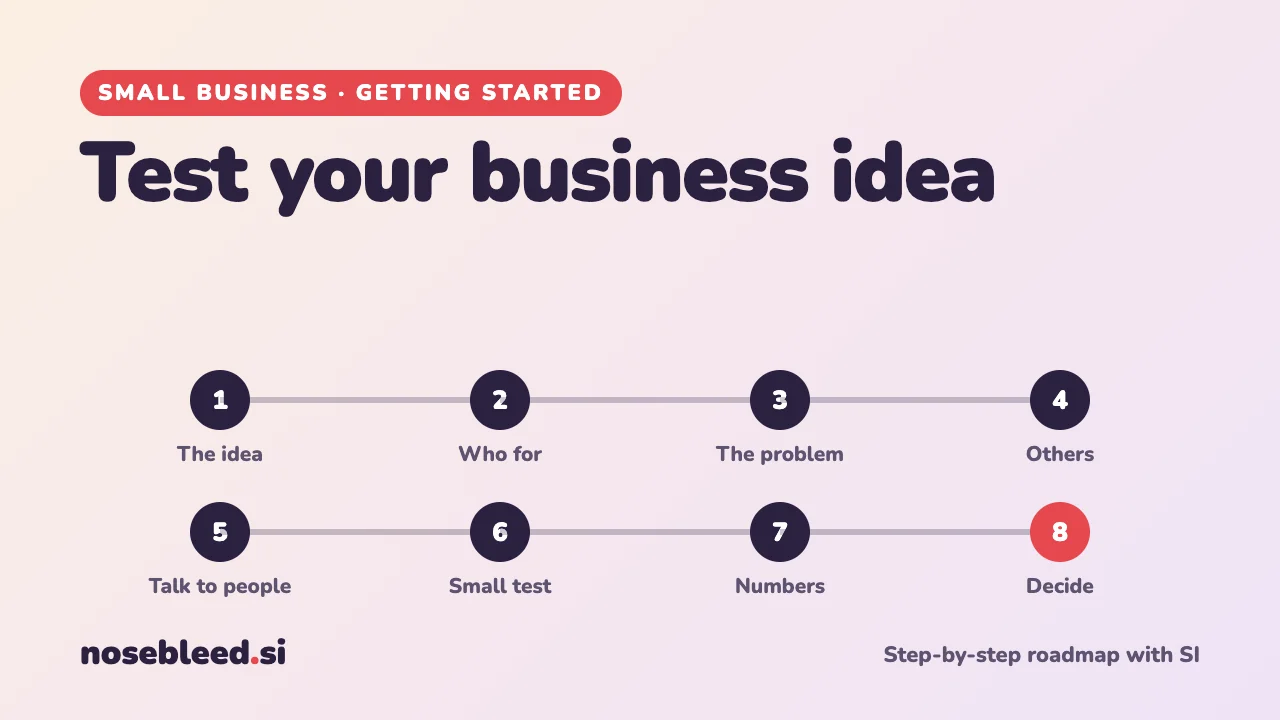
- 🗺️ 8 stages
- ⏱️ A few weeks, alongside other things
- 💷 Little or no money needed
Before you start
Where SI is a great help
- Asking the awkward questions a friend might not
- Thinking through customers and competitors
- Planning small, cheap tests
- Writing questions to ask real people
Where you stay in charge
- Talking to real potential customers: that part is yours.
- Checking what others really offer and charge locally.
- Being honest with yourself about what you find.
- The decision, and any money you put in.
SI tends to be encouraging. Ask it to be honest, and remember that the best evidence comes from real customers, not from SI. Before you rely on any facts or figures from SI, see Check what SI tells you.
The roadmap
Describe your idea simply
If you can't explain your idea in two sentences, customers won't understand it either. Say what you'll sell, to whom, and why they'd choose you.
Stage 1 promptI'm thinking of starting a business making and selling homemade dog treats at local markets and online. Interview me one question at a time to understand my idea. Then sum it up in two plain sentences: what I'd sell, to whom, and why they'd choose me.
Work out who it's for
"Everyone" isn't a customer. Picture the person most likely to buy: who they are, where they shop, and what they care about.
Stage 2 promptDescribe two or three kinds of customer most likely to buy from me: who they are, what they care about, where they'd find me, and what might stop them buying. Then tell me which to focus on first, and why.
Be clear about the problem you solve
People buy things that make life easier, better or more enjoyable. What's your customer's problem or wish, and how do they deal with it now?
Stage 3 promptWhat problem or wish would my business meet for these customers? How are they dealing with it now, and why might they switch to me? Be honest if you think the need is weak.
See who else does it
Competitors are a good sign: they show people already pay for this. Look at what they offer, what they charge, and what their customers say in reviews, good and bad.
Stage 4 promptI've looked at businesses like mine. Here's what I found: [what they offer, charge, and what their reviews say, without their names]. Where are the gaps? How could I be different in a way customers would actually care about?
SI may not know your local competitors or their current prices. Look online, on maps and in person.
Talk to real people
This is the most valuable step. Talk to ten or more people who might buy, not just friends and family. Ask about what they do now, not "would you buy this?", because people are kind and say yes.
Stage 5 promptWrite ten questions I could ask potential customers about my idea. Ask about what they do and spend now, and what frustrates them, not whether they like my idea. Make them friendly and quick, for a chat of about ten minutes.
Run a small test
The best test is whether people pay. Try selling in a small way before you invest: a market stall, a few pre-orders, a simple web page taking enquiries, or a trial for a few customers.
Stage 6 promptSuggest five cheap ways I could test whether people will really pay for my idea, in the next month, spending under £100. For each, say what I'd do, what it costs, and what result would be encouraging.
Do the rough numbers
Roughly: what will each sale cost you, what can you charge, and how many sales a week would you need to make it worthwhile? It doesn't need to be exact, just honest.
Stage 7 promptHere are my rough figures: [cost to make one, likely price, monthly running costs, what I'd like to earn]. How many sales a week would I need? Show your working, use only my figures, and tell me plainly whether that looks realistic.
For the full picture, see Price your products or services.
Decide: go, change or stop
Look honestly at what you've learned. Many good businesses started with an idea that changed after testing. Stopping early, having spent little, is a good outcome too.
Stage 8 promptHere's what I learned from talking to people and testing: [summary]. Help me decide honestly: go ahead, change the idea, or stop? What does the evidence say, and what would you test next?
Good follow-up questions
Tap a question to copy it.
Watch out for
- Only asking friends and family. They want to be kind. Strangers tell you more.
- "Would you buy it?" Saying yes is easy. Paying is the real test.
- Spending big before testing. Stock, equipment and websites can wait until you know people will buy.
See all our small-business guides
Spotted a mistake? Got a suggestion?
Tell us about this page. It helps us make it better for everyone.
Prefer email? Write to us at hello@nosebleed.si. We read every email, though we can't always reply.
Page ref SB-022 · Page last updated 20 November 2026