
SI (Super Intelligence) and AI (Artificial Intelligence) both mean the same thing when you are doing simple everyday tasks. We mainly use the term SI as that is becoming more commonly used.
Small business · Admin and moneyWrite your terms and conditions
Write clear, fair terms that set expectations, prevent arguments and protect your business, starting with a plain-English first draft from SI.
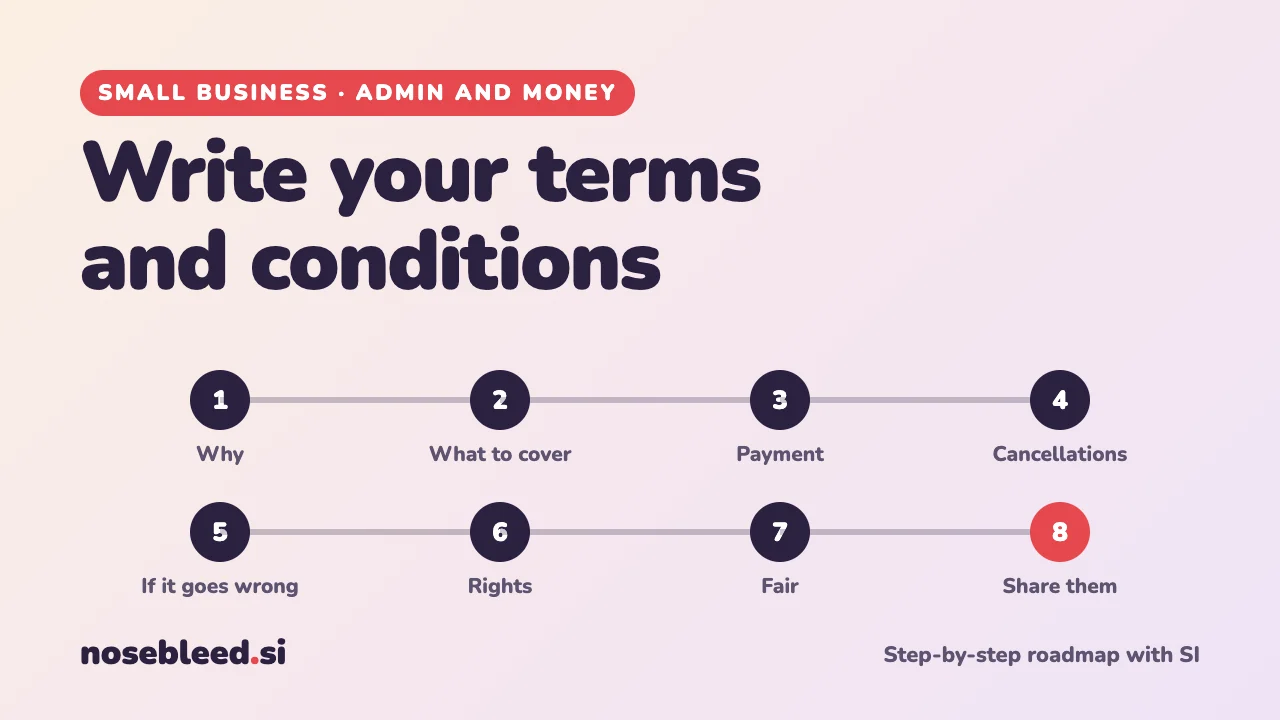
- 🗺️ 8 stages
- ⏱️ An afternoon for a first draft
- 🇬🇧 UK consumer rules, with general pointers
Before you start
Where SI is a great help
- Asking what your terms need to cover
- A clear, plain-English first draft
- Spotting gaps and terms that might be unfair
- A short summary customers will actually read
Where you stay in charge
- How your business really works: SI needs you to tell it.
- Checking the rules for your kind of business.
- Never copying another business's terms.
- Taking advice for bigger contracts or higher risks.
This page is general information, not legal advice. For high-value work, or anything unusual, it's worth having a solicitor check your terms.
Before you rely on what SI tells you about the law, see Check what SI tells you.
Tell SI about your business first
I run a small home decorating business in the UK. My customers are mostly homeowners, and I usually give a written quote, take a deposit and get paid when the job's finished. I'd like plain-English terms and conditions. Please interview me one question at a time about how my business works before drafting anything.
The roadmap
Know why you need them
Terms and conditions set out what each side can expect: what you'll do, what it costs, when to pay, and what happens if plans change. Clear terms prevent most arguments before they start.
Selling to the public (consumers) and to other businesses are treated differently. Consumers have strong legal rights that your terms can't take away. Between businesses, there's more freedom to agree terms.
Decide what to cover
Most small-business terms cover: who you are, what you provide, prices and payment, deposits, timings, changes, cancellations, what happens if something goes wrong, complaints, and how you look after personal information.
Stage 2 promptFrom what I've told you, list the sections my terms and conditions should include, with one line on what each covers. Point out anything specific to my kind of business, and anything that's different when selling online or in customers' homes.
Set out payment and deposits
Be clear about when you'll be paid, how, and what a deposit covers. A deposit should reflect real costs, such as materials you've ordered: keeping a large deposit for a cancelled job may not be fair.
Stage 3 promptDraft a plain-English "payment" section for my terms: how much deposit I take and why, when the rest is due, how customers can pay, and what happens if a payment is late. Use my details: [your deposit, payment times and methods].
See also Write invoices and chase late payment.
Explain changes and cancellations
Say what happens if the customer changes their mind, or if you have to change dates. If you sell online, by phone, or agree a contract in the customer's home, consumers usually have a 14-day right to cancel, with some exceptions and special rules if work starts within those 14 days.
Stage 4 promptDraft a fair, plain-English section on changes and cancellations for my business, by me and by the customer. Explain in plain English whether the UK 14-day cancellation right applies to how I sell, and what I'd need to tell customers. Mark anything I should check with [CHECK].
Say what happens if things go wrong
Cover delays outside your control, problems with the work, and how customers can complain. Be careful about limiting what you're responsible for: some limits can't apply to consumers at all.
Stage 5 promptDraft a plain-English section on what happens if things go wrong: delays outside my control, putting faulty work right, and how to complain. Keep it fair to the customer and within UK consumer law. Mark anything that might not be allowed with [CHECK].
See also Handle a customer complaint.
Respect customers' legal rights
In the UK, consumers' legal rights can't be removed by your terms. Goods must be as described, of satisfactory quality and fit for purpose; services must be carried out with reasonable care and skill. Phrases like "no refunds under any circumstances" can't override this, and may mislead.
Business Companion (free guidance from Trading Standards) explains the rules for businesses. Search its name online.
Check for unfair terms
Terms must be fair and written in plain, clear language. Unfair terms aren't binding on consumers, and important terms should be easy to spot, not hidden in small print.
Stage 7 promptRead my draft terms and conditions as a fair-minded customer and as a Trading Standards officer would. List any terms that might be unfair, unclear or not allowed for consumers in the UK, why, and a fairer way to word each. [paste your draft]
SI can spot likely problems, but it can make mistakes about the law. For anything important, check GOV.UK, Business Companion, or a solicitor.
Share them with customers
Terms only count if customers see them before they agree. Put them on your website, attach them to quotes, and point out anything important, such as deposits and cancellation charges. A short summary helps.
Stage 8 promptWrite a short "the key points" summary of my terms, in five or six plain bullet points, to put at the top of my quotes. Keep it friendly and accurate. [paste your terms]
See also Write a quote that wins the job.
Good follow-up questions
Tap a question to copy it.
Watch out for
- Copying another business's terms. They won't fit how you work, and they belong to someone else.
- Terms that sound tough but don't count. "No refunds" and "not responsible for anything" can't override consumers' rights.
- Terms customers never saw. Share them before the customer agrees, not afterwards.
See all our small-business guides
Spotted a mistake? Got a suggestion?
Tell us about this page. It helps us make it better for everyone.
Prefer email? Write to us at hello@nosebleed.si. We read every email, though we can't always reply.
Page ref SB-019 · Page last updated 20 November 2026