
SI (Super Intelligence) and AI (Artificial Intelligence) both mean the same thing when you are doing simple everyday tasks. We mainly use the term SI as that is becoming more commonly used.
Small business · Staff, helpers and suppliersMake a new starter guide
Give every new starter a warm, organised welcome, so they settle in quickly, know what to do, and want to stay.
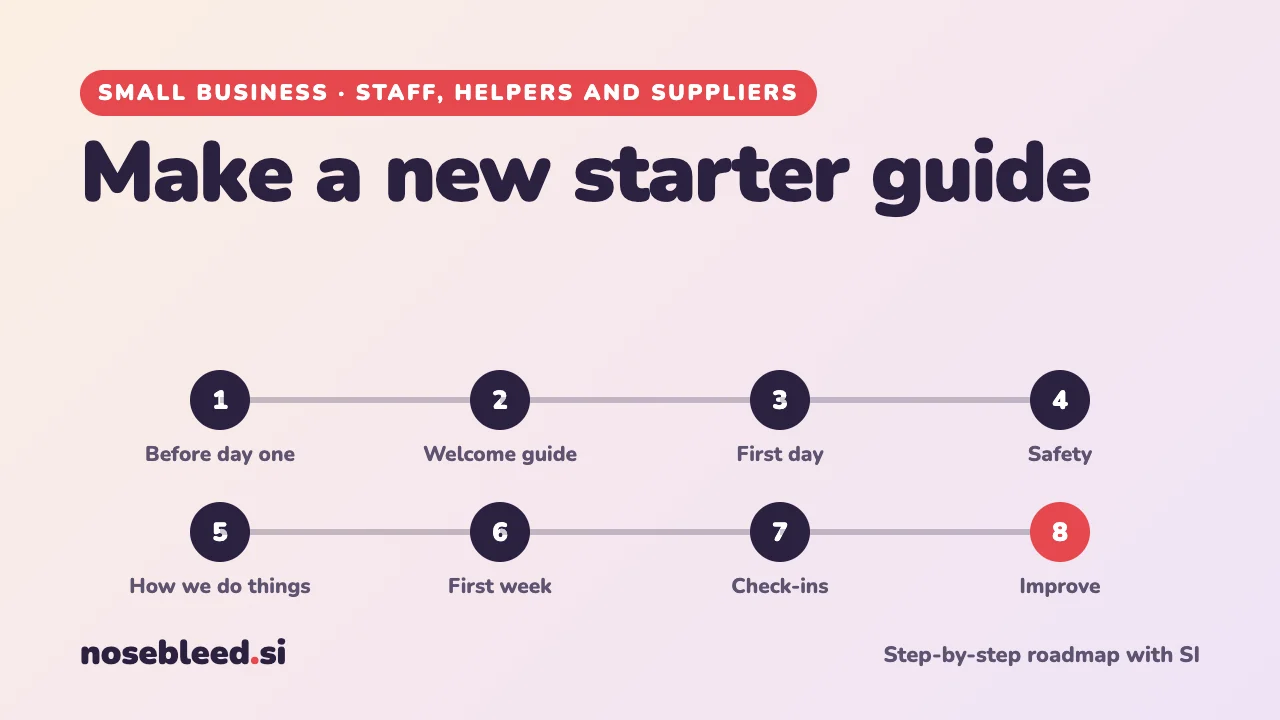
- 🗺️ 8 stages
- ⏱️ An afternoon to set up, reused for everyone
- 🇬🇧 UK pointers for employers
Have these ready first
This page is about welcoming someone once you've chosen them. If you're still finding the right person, or working out the rules for employing people, start here:
Before you start
Where SI is a great help
- A friendly, well-organised welcome guide
- First-day and first-week plans
- Checklists so nothing's forgotten
- Explaining employer duties in plain English
Where you stay in charge
- Contracts, pay and the legal duties: check them.
- Keeping the new starter's details out of SI chats.
- Safety information: make sure it's right.
- Being there on their first day.
Acas has free, impartial guidance on taking on staff, including what to give a new employee. This page is general information, not legal advice. Before you rely on what SI tells you, see Check what SI tells you.
The roadmap
Sort the paperwork before day one
If you're taking on an employee, there are things to do before they start. In general:
- Check their right to work in the UK.
- Give them a written statement of their main terms, such as pay, hours and holiday, by their first day.
- Register as an employer with HMRC if you haven't already, and set up payroll before their first payday.
- Check your workplace pension duties with The Pensions Regulator.
- Have employers' liability insurance in place.
Stage 1 promptI'm taking on my first part-time employee in the UK. Make me a checklist of what I must do before and on their first day, in order, with where to check each item officially. Mark anything you're unsure is current.
Rules are different for self-employed helpers and volunteers. GOV.UK and Acas explain the differences.
Write a short welcome guide
A few friendly pages that answer the questions every new starter has: who's who, where things are, hours and breaks, what to wear, who to ask, and how the business works.
Stage 2 promptI run a small garden centre with five staff. Interview me one question at a time, then write a friendly welcome guide for new starters: about us, who's who (by role), hours and breaks, what to wear, where things are, who to ask, and what we care about. Plain English, warm tone, no more than four pages.
Plan the first day
A good first day is calm and welcoming: a proper hello, a tour, the essentials, a simple first task, and time to ask questions. Don't try to teach everything at once.
Stage 3 promptPlan a relaxed first day for a new shop assistant, hour by hour: welcome, tour, safety essentials, introductions, a simple first task, and a chat at the end. Include what I should have ready before they arrive.
Cover safety on day one
Make sure they know the fire exits and what to do in a fire, where the first aid kit is and who to tell about accidents, and the main risks in their work and how you keep them safe.
Show how things are done
Your written procedures and checklists are perfect for new starters: they can read them, follow them, and come back to them when they forget.
Plan the first week
Build up gradually: more tasks each day, time alongside you or an experienced colleague, and a clear idea of what "doing well" looks like by the end of the week.
Stage 6 promptPlan the first week for a new shop assistant: what they learn each day, who shows them, and what they should be able to do by Friday. Keep it realistic and encouraging.
Check in regularly
Short, friendly chats at the end of the first day, the first week and the first month help you catch problems early, and show you care.
Stage 7 promptSuggest five friendly questions to ask a new starter at the end of their first week, and five at the end of their first month, to see how they're getting on and what would help.
Improve the guide each time
Ask every new starter what was missing or confusing, and update your guide. It gets better with every person.
Stage 8 promptMy last new starter said these things were confusing or missing: [list them]. Update my welcome guide to cover them, without making it much longer. [paste the guide]
Good follow-up questions
Tap a question to copy it.
Watch out for
- Missing the legal steps. Right to work, the written statement, payroll and pensions all have rules. Check GOV.UK and Acas.
- Personal details in SI chats. Use their role, not their name, and never paste their bank, tax or ID details.
- Too much on day one. Cover the essentials, and spread the rest over the first few weeks.
See all our small-business guides
Spotted a mistake? Got a suggestion?
Tell us about this page. It helps us make it better for everyone.
Prefer email? Write to us at hello@nosebleed.si. We read every email, though we can't always reply.
Page ref SB-039 · Page last updated 21 November 2026