
SI (Super Intelligence) and AI (Artificial Intelligence) both mean the same thing when you are doing simple everyday tasks. We mainly use the term SI as that is becoming more commonly used.
Small business · Getting startedUnderstand the rules for your business
Work out which rules apply to your business, in plain English, and make a checklist of what to do, so nothing important is missed.
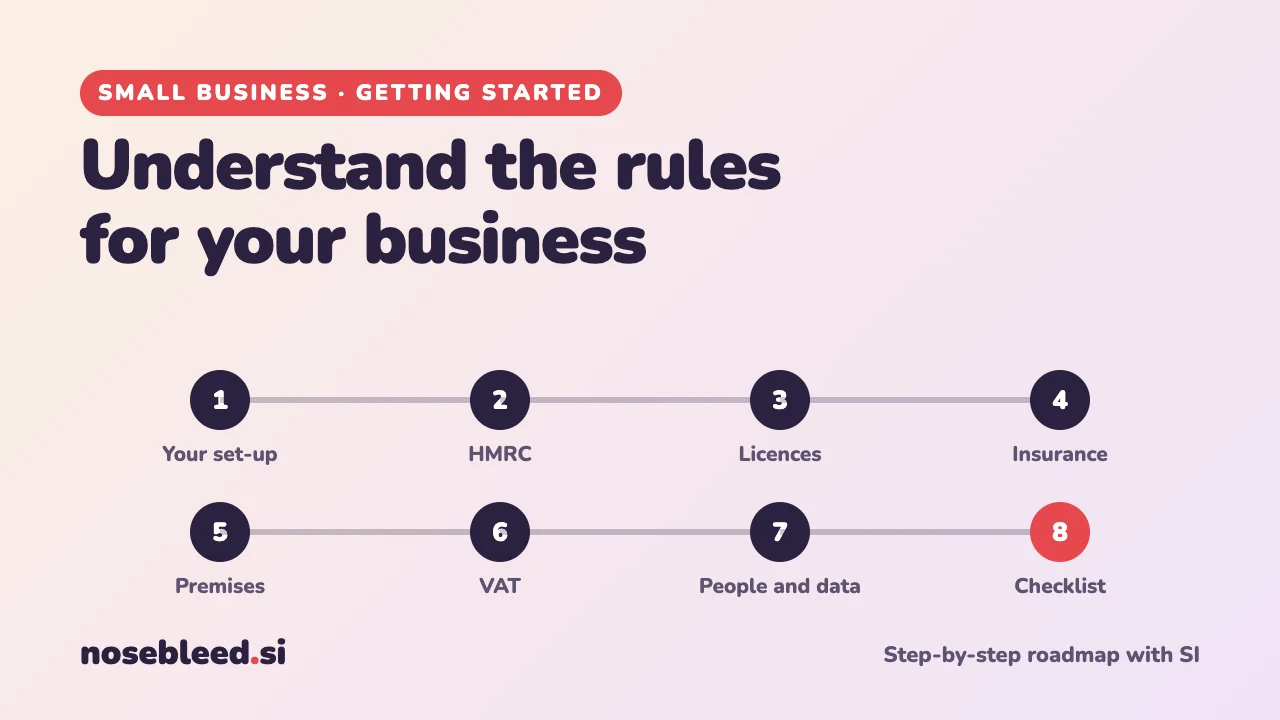
- 🗺️ 8 stages
- ⏱️ An evening, then a few calls
- 🇬🇧 UK rules, signposted to GOV.UK
Before you start
Where SI is a great help
- Explaining the rules in plain English
- Asking the questions that show what applies to you
- Turning it all into a checklist
- Preparing questions for an accountant or adviser
Where you stay in charge
- Checking every rule on GOV.UK or with your council.
- Deadlines and figures: these change.
- The rules for your trade, which can be very specific.
- Taking advice for anything you're unsure of.
Most rules are the same across the UK, but some differ in Scotland, Wales and Northern Ireland. Free local business support can help: Growth Hubs in England, Business Gateway in Scotland, Business Wales and Invest Northern Ireland. This page is general information, not legal or tax advice. Before you rely on what SI tells you about the rules, see Check what SI tells you.
Tell SI about your business first
I'm starting a home baking business, selling cakes at markets and to cafés, in England. I'll be working on my own, from my home kitchen. Please help me understand which UK rules apply to me, step by step. Ask me one question at a time first, and tell me where to check each thing officially.
The roadmap
Choose how your business is set up
Most small businesses start as a sole trader: simple to set up, and you and the business are legally the same. A limited company is a separate legal body, with more paperwork but some protection for your personal money. Some people go into business together as a partnership.
Stage 1 promptExplain the difference between a sole trader, a partnership and a limited company in the UK, in plain English: paperwork, tax, personal risk and cost. Then ask me a few questions and suggest which might suit me, and whether I should ask an accountant.
Tell HMRC
Sole traders generally need to register for Self Assessment with HMRC if their self-employed income is more than a certain amount in a tax year, which can change year by year, and there's a deadline for registering. Limited companies register with Companies House and have their own tax and filing duties. Check the details and deadlines on GOV.UK.
See also Keep track of income and expenses.
Check for licences and registrations
Some trades need a licence or registration before you start. Examples include selling or serving food (register with your council at least 28 days before you start), alcohol, street trading, taxis, childminding, animal boarding, and playing music in public. Your local council is usually the place to ask.
Stage 3 promptWhat licences, registrations or permissions might a business like mine need in the UK? List each, who issues it, and roughly when I'd need it. Mark anything you're unsure of, and tell me what to search for on GOV.UK or my council's website.
Get the right insurance
- Employers' liability insurance is a legal requirement for most businesses with employees.
- Public liability insurance isn't required by law, but many customers, venues and markets expect it.
- Other cover to think about: your equipment and stock, professional mistakes, and using your vehicle for work.
Stage 4 promptWhat kinds of business insurance should someone like me think about? Explain each in plain English, which is legally required, and what questions to ask an insurer or broker. Don't recommend any company.
Check your premises, or your home
Working from home? Tell your home insurer, and check with your mortgage lender or landlord. Most people working from home don't pay business rates, but it can depend on how you use the space. If you rent or buy business premises, you may need to pay business rates, and there's relief for some small businesses.
Stage 5 promptI'll be running my business from my home. What should I check with my insurer, mortgage lender or landlord, and my council? Make it a short checklist, and tell me where to check business rates rules.
Keep an eye on VAT
Once your VAT-taxable turnover goes over a set amount, you must register for VAT. The threshold can change, so check the current figure on GOV.UK. Keep an eye on your rolling 12-month total as you grow.
See also Price your products or services.
Know the rules on people, data and selling
As you grow, other rules come in: employing people, looking after customers' information, and selling to the public. Each has its own roadmap here.
Write a job advert Keep customer information safe Write your terms and conditions
Make your own checklist
Pull it all together into one checklist, with what to do, where to check, and by when.
Stage 8 promptFrom everything we've discussed, make me a checklist of the rules and registrations that apply to my business, in the order I should do them. For each: what to do, where to check it officially, any deadline, and a box to tick. Mark anything I should confirm with an accountant or my council.
Good follow-up questions
Tap a question to copy it.
Watch out for
- Out-of-date figures and deadlines. Thresholds and dates change. Always check GOV.UK.
- Paying for things that are free. Registering with HMRC and searching Companies House are free on GOV.UK. Be wary of websites that charge for them.
- Rules specific to your trade. Ask your council, or your trade association if you have one.
See all our small-business guides
Spotted a mistake? Got a suggestion?
Tell us about this page. It helps us make it better for everyone.
Prefer email? Write to us at hello@nosebleed.si. We read every email, though we can't always reply.
Page ref SB-025 · Page last updated 21 November 2026