
SI (Super Intelligence) and AI (Artificial Intelligence) both mean the same thing when you are doing simple everyday tasks. We mainly use the term SI as that is becoming more commonly used.
Small business · Staff, helpers and suppliersPlan an interview
Run a fair, friendly interview that helps you choose the right person, and stay within the rules.
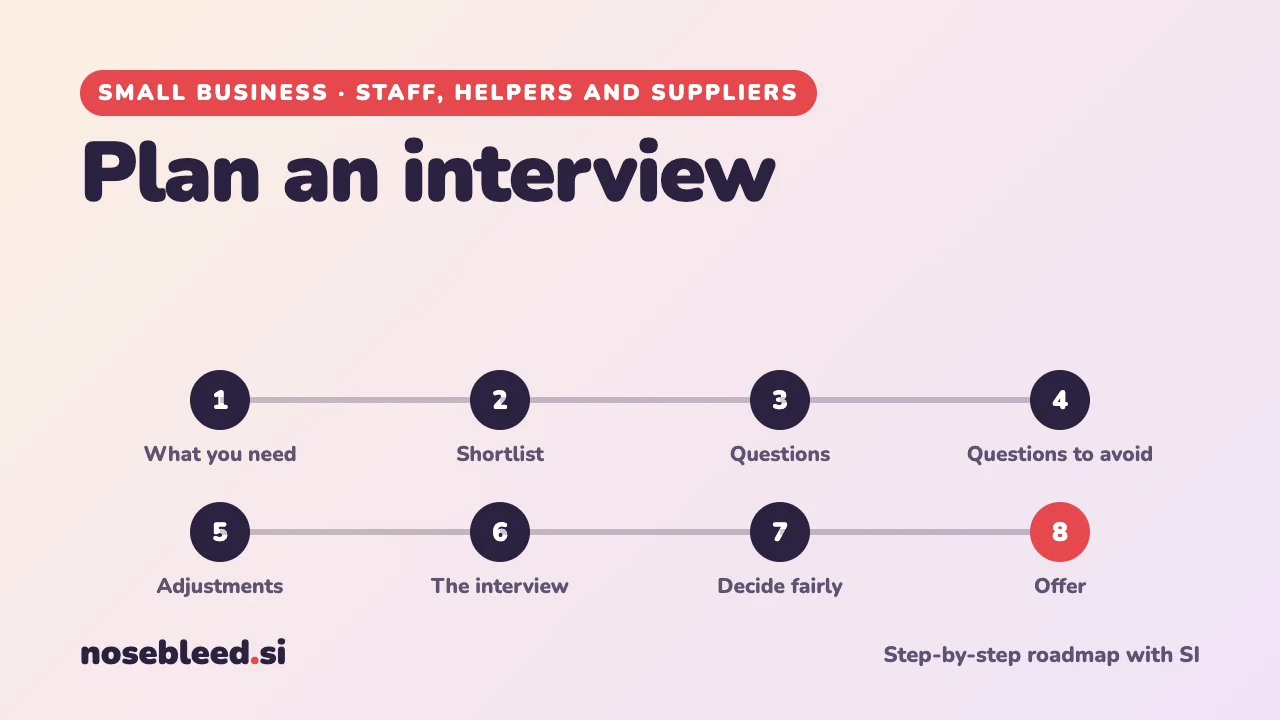
- 🗺️ 8 stages
- ⏱️ An hour to prepare
- 🇬🇧 UK pointers for employers
Have these ready first
An interview is much easier once you know exactly what the job involves, and you've had applications from a clear, fair job advert. If you haven't got there yet, start here:
Before you start
Where SI is a great help
- Good questions that relate to the job
- A simple, fair scoring sheet
- Explaining the rules in plain English
- Offer and "sorry" emails
Where you stay in charge
- Treating every candidate fairly.
- Keeping candidates' details out of SI chats.
- The final decision: never let SI choose.
- Checking the legal points with Acas or GOV.UK.
Acas has free, impartial guidance on recruitment, including interviews. This page is general information, not legal advice. Before you rely on what SI tells you, see Check what SI tells you.
The roadmap
Be clear what you're looking for
List what someone really needs to do the job well, the "essentials", and what would be nice to have. These become the fair basis for every decision you make.
Stage 1 promptI'm hiring a part-time assistant for my garden centre. Here's the job description: [paste it]. Help me list the essential and desirable skills and qualities, based only on what the job really needs.
Shortlist fairly
Compare each application against your essentials list, in the same way for everyone. Read applications yourself rather than pasting them into SI: they contain personal information.
Stage 2 promptMake me a simple shortlisting sheet for this job: my essential and desirable criteria down one side, and a way to mark each application against them. I'll fill it in myself.
Prepare your questions
Ask every candidate the same main questions, based on the job. Questions like "Tell me about a time when…" help people give real examples. Add one or two practical tasks if they suit the job.
Stage 3 promptWrite eight interview questions for this job, based only on my essential and desirable criteria. Include some "tell me about a time when" questions, and one short practical task. For each, say what a good answer might include.
Know which questions to avoid
Under the Equality Act 2010, you mustn't treat people unfairly because of things like their age, disability, sex, race, religion, sexual orientation, pregnancy, or marriage or civil partnership. Avoid questions about these, such as "Do you have children?" or "When did you leave school?".
In general, you shouldn't ask about health or disability before offering someone a job, except in a few cases, such as asking whether they need any adjustments for the interview.
Stage 4 promptCheck my interview questions for anything that could be unfair or discriminatory under UK equality law, and suggest better wording that focuses on the job. Tell me where to check on Acas or GOV.UK. [paste your questions]
Offer adjustments
When you invite someone to interview, ask whether they need anything to help them take part, such as step-free access, extra time, or questions in writing. Then make the changes you reasonably can.
Stage 5 promptWrite a friendly interview invitation email: the date, time and place with [gaps], how long it will take, who they'll meet, what to bring, and a line asking whether they need any adjustments to take part.
Run a friendly interview
- Put them at ease: a warm welcome and a quick outline of what will happen.
- Ask your main questions in the same order for everyone.
- Take short notes on their answers, about the job only.
- Tell them about the job honestly: pay, hours, and what it's really like.
- Give them time for their own questions, and say when they'll hear from you.
Decide fairly
Score each candidate against your criteria straight after their interview, while it's fresh. Make the decision yourself, based on the evidence, not on who you got on with best.
Stage 7 promptMake me a simple scoring sheet for my interview questions, with a score of 1 to 4 for each and a box for notes. Explain how to use it fairly and consistently for every candidate.
Keep your notes safe, and only as long as you need them. See Keep customer information safe: the same care applies to candidates.
Make an offer, and let others down kindly
Offers are often "conditional" on things like references and right to work checks. Tell unsuccessful candidates promptly and kindly, and offer brief feedback if you can.
Stage 8 promptWrite (1) a warm job offer email, conditional on references and right to work checks, with [gaps] for pay, hours and start date; and (2) a kind, brief email to candidates who weren't successful, thanking them for their time.
Good follow-up questions
Tap a question to copy it.
Watch out for
- Candidates' details in SI chats. Never paste CVs or application forms into SI. Use the job, not the person.
- Letting SI choose. SI can help you prepare, but the decision must be yours, made fairly.
- Questions about personal life. Stick to the job. Personal questions can be discriminatory, even when meant kindly.
See all our small-business guides
Spotted a mistake? Got a suggestion?
Tell us about this page. It helps us make it better for everyone.
Prefer email? Write to us at hello@nosebleed.si. We read every email, though we can't always reply.
Page ref SB-048 · Page last updated 22 November 2026